


An HNI homeowner building a private cinema usually already owns the best version of everything: a serious screen, a powerful, properly engineered sound system and an acoustically treated room that is sound-proof like a good theatre.
If you have to search for all your remote controls, arrange the furniture a certain way and it takes you at least ten minutes before you can dive into a movie, then it’s not a truly luxurious experience.
Imagine a room where you walk in, choose the mood and let the room take care of the rest.
Interested to know how you can get this for your home theatre? Read on…
What actually separates the two
A regular home theatre is a collection of individually excellent parts, a projector, a receiver, a speaker set, a streaming box, each switched on and set up by hand.
A fully automated cinema, instead of building around individual devices, is built around the experience you, the homeowner, wants. Every system, sound, light, temperature, shading, gets tied together to deliver it on command.
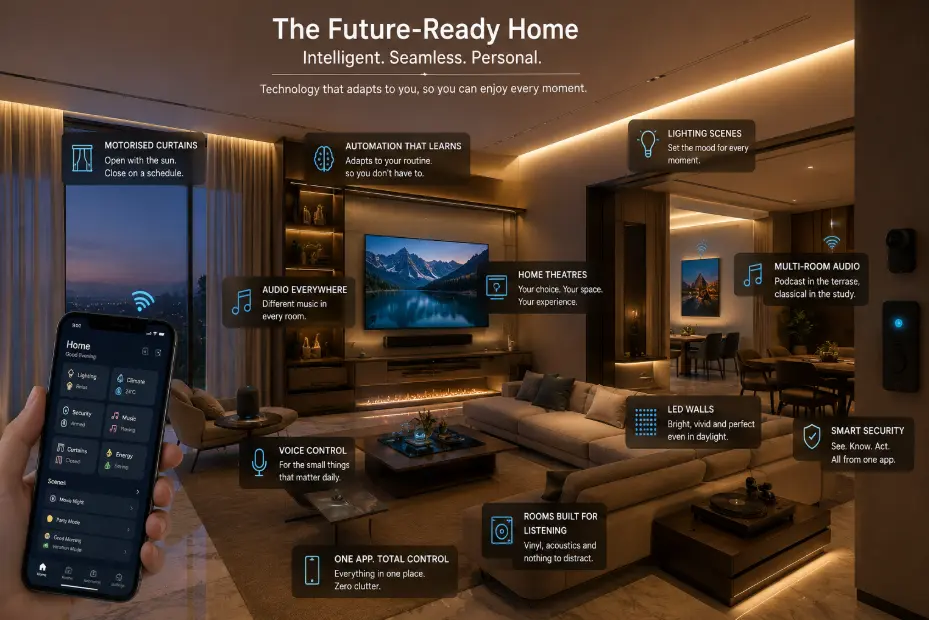
For example, one person’s original setup could be a Crestron remote, a separate app for the AV receiver, another for the lighting and long ceiling curtains.
Before watching a movie, they would have to look for four different devices and have to individually set everything ‘right’ to create an ambience after which they can finally start watching the movie.
If we rebuild the room, all of that would collapse into something like a single Control4 interface: one button labelled “Movie Night” that activates a sequence, in the right order, every time.
How would it look in practice? The curtains close, lighting drops to a preset level, the display comes on, already set to your preferences, audio loads its configured mode, the air conditioning cools the room to your desired temperature. And the film starts.
All this happens with minimal, almost zero effort on your part. You didn’t have to touch a second control after selecting ‘Movie Night’.
Sound engineered around the listener
We know how important sound is to a movie-watching experience. When we enter a movie hall, it’s the first thing that hits us: that epic sound.
A regular home theatre setup with even a decent 5.1 or 7.1 system, plays sound from all around you on the horizontal plane, meaning it can come from your left, right, centre and maybe even behind. If you add Dolby 11.2 or 13 channels, which come with height speakers, sound also comes from above you. So, a scene where a chopper is flying overhead would actually sound like it’s over your head.
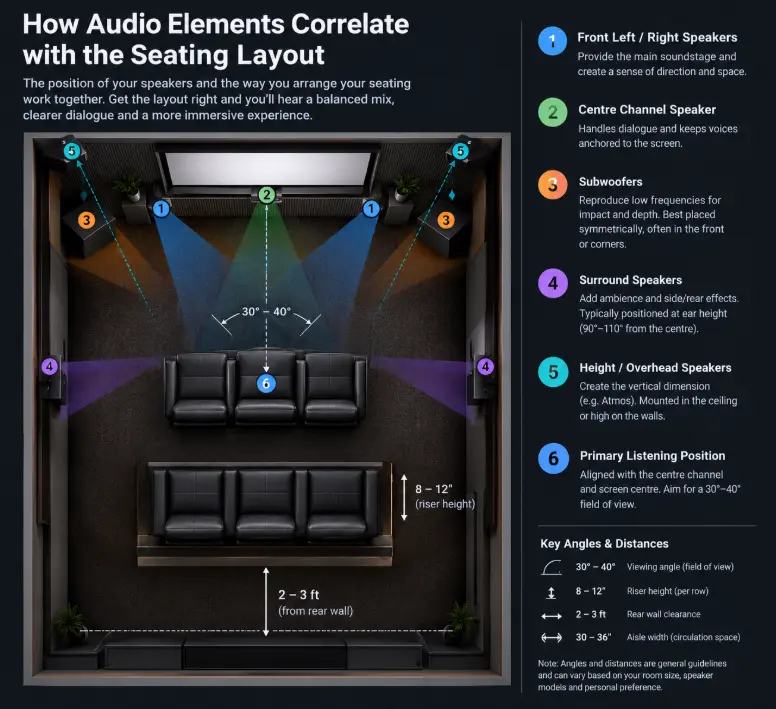
Multiple subwoofers solve a problem most home setups don’t even know they have: A single subwoofer creates dead spots in a room where bass barely registers, so depending on where you’re sitting, an explosion might feel either powerful or flat. You can solve this problem by spreading the bass across two or more subs, by using multiple subs. Once someone professionally calibrates your multiple subwoofer system, it ensures that every seat in the room will get a consistent, accurate sound.
Without proper acoustic treatment, even the best gear can sound quite average. Hard walls and ceilings bounce sound around and blur the detail, so even a well-specified system ends up sounding worse than it should. Acoustic treatment fixes that at the source, which is why a well-designed room with fewer speakers can often sound better than a poorly treated one with more.
Picture at a different scale
LED walls solve the biggest limitation of projection outright: brightness. Most projectors lose contrast the moment any daylight enters the room. An LED wall doesn’t have that problem. It holds full brightness and contrast regardless of ambient light and there’s no bulb to swap out three years in.
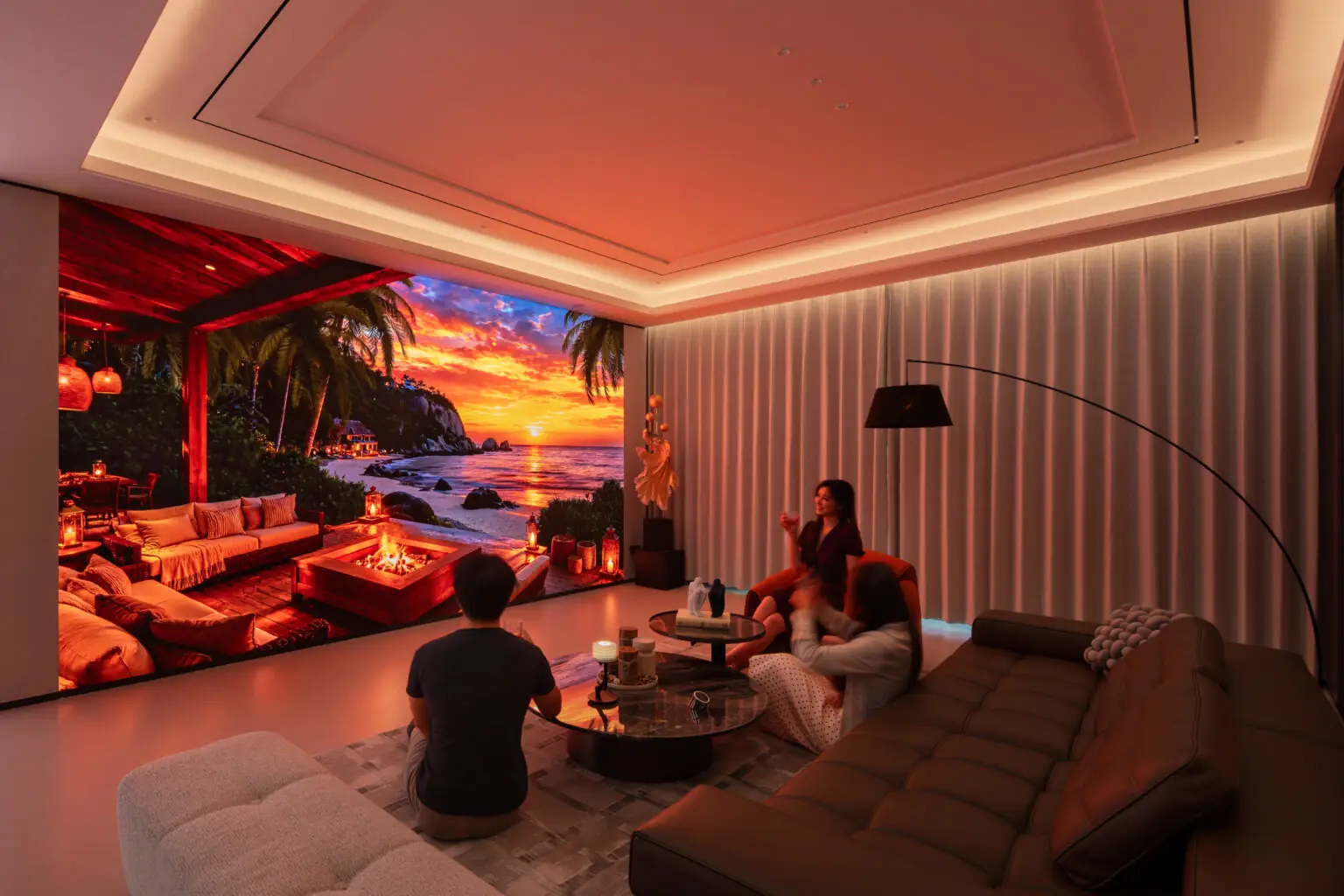
Image Souce – Ledman Blog page
Projection still has its place in a dedicated blackout room built with the right throw distance and for very large screen sizes it can be the more practical choice on cost. But for a room that isn’t sealed off from daylight, or one that doubles as something other than a screening room, like a living room, LED is usually the better call.
Lighting designed around the day, not just the film
Human-centric lighting shifts colour temperature and brightness across the day on its own. It can be cooler and brighter in the morning when you have to get things done and warmer and dimmer by evening, so you can start to relax.
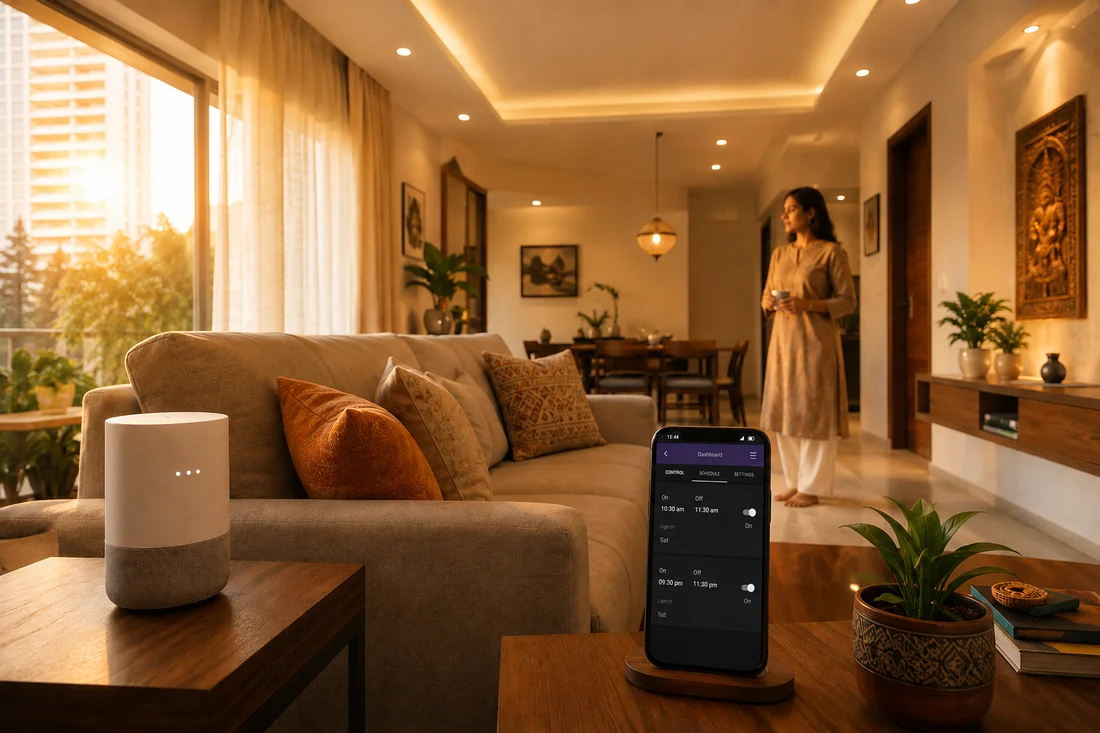
Image Source: Lotics Blog Page
Smart rooms can track how the room gets used and automate your preferred changes. Scene presets handle the film separately: near-dark once the movie starts, a low pathway glow if someone pauses for an intermission, back to normal lighting when it’s over.
A single system running the whole room
The control layer is usually built on one of a handful of established platforms such as Crestron, Control4 or Savant tend to anchor the AV and automation side. Lutron is usually preferred for handling lighting and shading, because its dimming and scene control integrates cleanly with the others
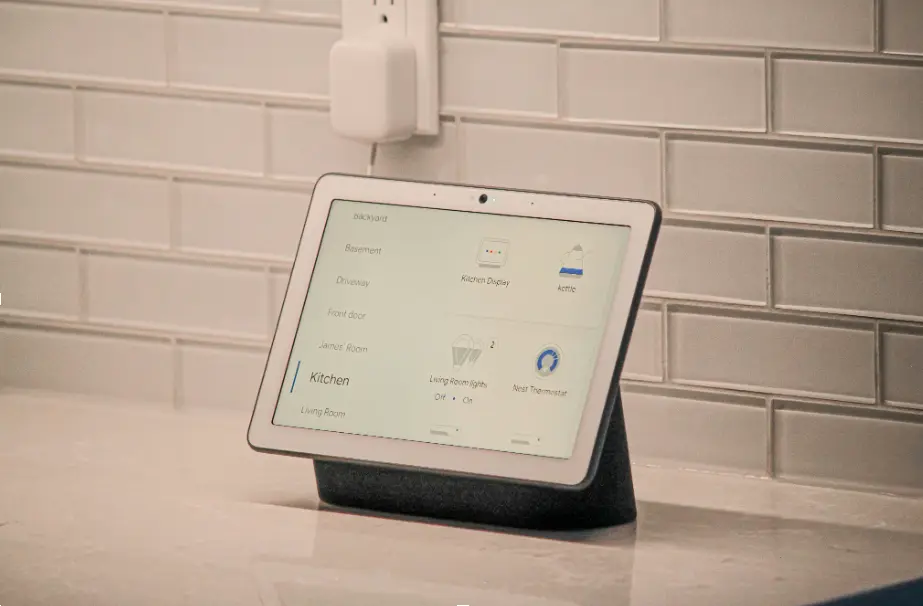
A Kaleidescape system gives centralised access to a film library at full disc-quality bitrate. So you don’t have to rely on a streaming box plugged into just one zone.
Whichever combination you use, the principle is the same: the curtains, air conditioning, display and audio all sit on the same platform and respond to the same programmed scenes.
Audio that extends across the home
In larger residences, the cinema is rarely the only room where sound quality matters.
Dante-based audio routing carries high-quality sound to a terrace, a games room or a pool area over standard network infrastructure, with routing and volume managed from one central point rather than through separate amplifiers wired room by room.
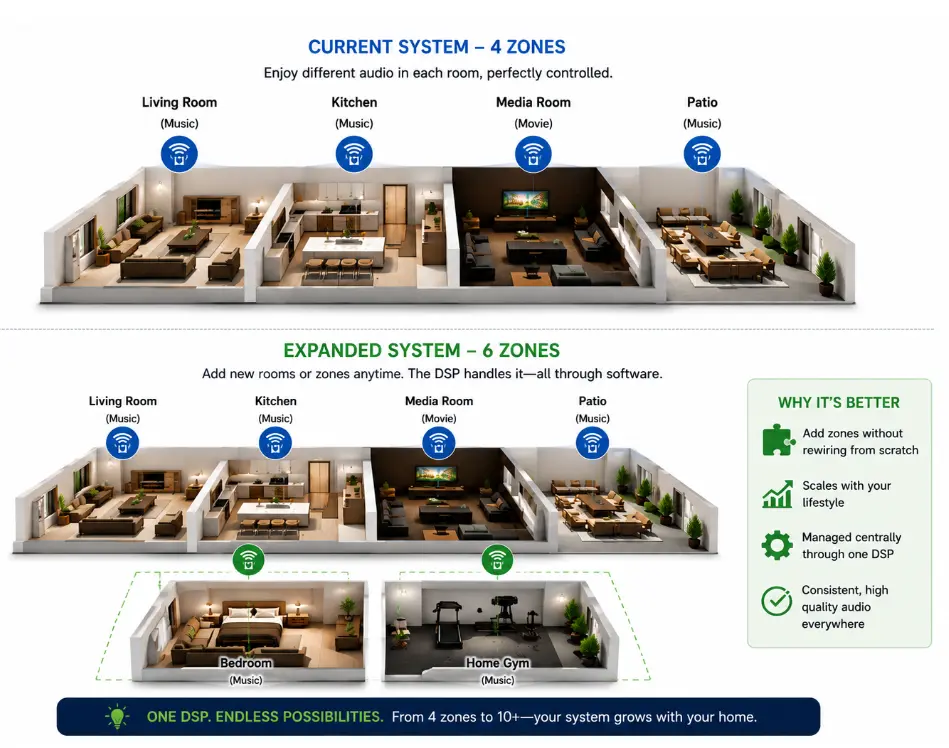
So when there’s a huge party at your place, some people can chill on the terrace listening to some old Bob Dylan tunes, while another set of people can be trading dance moves by the pool. And all this happens while the kids in the house watch that same Peppa Pig episode for the tenth time. And all this happens with perfect volume for each zone, with the sound of one zone not interrupting the one in the adjacent area.
Planned this way, the entire home’s audio becomes one coordinated system rather than a series of installations that never quite talk to each other.
Comparing the two experiences
| Feature | Traditional Home Theatre | Fully Automated Luxury Cinema |
|---|---|---|
| AV control | Separate remotes per device | Centralised control across the system |
| Lighting | Manually switched or dimmed | Scene-based, including human-centric lighting |
| Shading and curtains | Manually operated | Motorised, integrated into cinema scenes |
| HVAC | Controlled separately | Coordinated with the viewing experience |
| Audio | Fixed configuration, manual selection | High-channel immersive audio with room-wide routing |
| Room preparation | You set up manually | Room transitions automatically into viewing mode |
| Technology visibility | Equipment and controls on display | Concealed within the architecture |
| Scalability | Devices added individually over time | Built as an ecosystem designed to expand |
What the investment actually covers
A cinema like this can run anywhere from a well-specified single-room build to a seven-figure project, depending on screen size, channel count, acoustic work and how much of the home the automation extends into.
Two projects with an identical equipment list on paper can land at very different price points once you factor in how much of that equipment actually gets wired into one system versus installed as standalone pieces.
That difference is where most of the cost sits.
A 13-channel Atmos system installed without acoustic treatment underneath it, or a control system integrated with only half the devices in the room, ends up costing nearly as much as the fully integrated version while performing at a fraction of it. Paying for the integration work is what actually determines whether the finished room performs the way you want it to.
Conclusion
Luxury home cinema is evolving from a collection of separate AV components into fully integrated spaces shaped around your lifestyle. High-performance displays, immersive sound, acoustic treatments, lighting, shading, climate control and automation work in harmony, allowing the entire room to respond as a unified environment.
The result is an immersive experience like never before, with significantly less complexity. You do not need to operate multiple systems or understand how they interact. A single command can prepare the room, begin the viewing experience and restore the space to its preferred settings when the session is over.
This is the new definition of luxury: making technology way less noticeable while making the experience way more intuitive and effortless.
Actis Luxe Homes combines AV integration, lighting control, environmental management and residential automation to create private cinemas that are simpler to operate, tailored to your preferences and seamlessly integrated into the wider home.
Getting there
Building a cinema like this starts with the room, the acoustics, the lighting and the control system planned together from day one.
If you’re planning a private cinema and want it built this way from the ground up, our team of experts can walk you through what that looks like for your space. Get in touch with us today, let us help you build that perfect home theatre.
FAQs
Everything in the room, AV, lighting, shades, HVAC, sits on one control platform instead of running as separate systems. A single scene selection can trigger several of them at once.
Yes. And it’s fairly standard in a properly designed setup. Both get coordinated through the same scenes as the AV system, so the room’s temperature and lighting shift automatically when a film starts rather than needing separate adjustment.
No, not directly. A projector performs the same whether or not it’s automated; what automation does is control the environment around it consistently and it’s the acoustic design, calibration and equipment choice that actually determine performance.
Often, yes, though it depends heavily on what’s already installed. Existing wiring, network infrastructure and whether the current AV and lighting hardware supports integration all factor in, which is why this usually starts with an assessment rather than a straight quote.
A pile of smart devices from different brands rarely works as a single coherent system, they each need their own app, their own logic and don’t always talk to each other well. An integrator designs the whole thing, AV, lighting, acoustics, climate and control, as one system from the outset, which is the difference between a room that works and a room that mostly works most of the time.