


Most enterprise displays installed over the last decade run on SMD (Surface Mount Device) Active LED. It's a mature, well understood technology and it still does the job in a lot of rooms.
Let’s find out what brought about this shift, what changes with COB, where that shows up in practice and how to figure out which one suits a given space.
How the two are built
SMD LEDs are packaged individually, then each package is mounted onto the display module. You end up with a surface made of many small, separate units, each with a visible edge and a small gap around it.
In the case of COB, the LED chips are mounted straight onto the board. There is no individual packaging and they are covered with a single protective layer that seals the whole surface. The chips sit much closer together than SMD packages, since there’s no casing around each one taking up room.
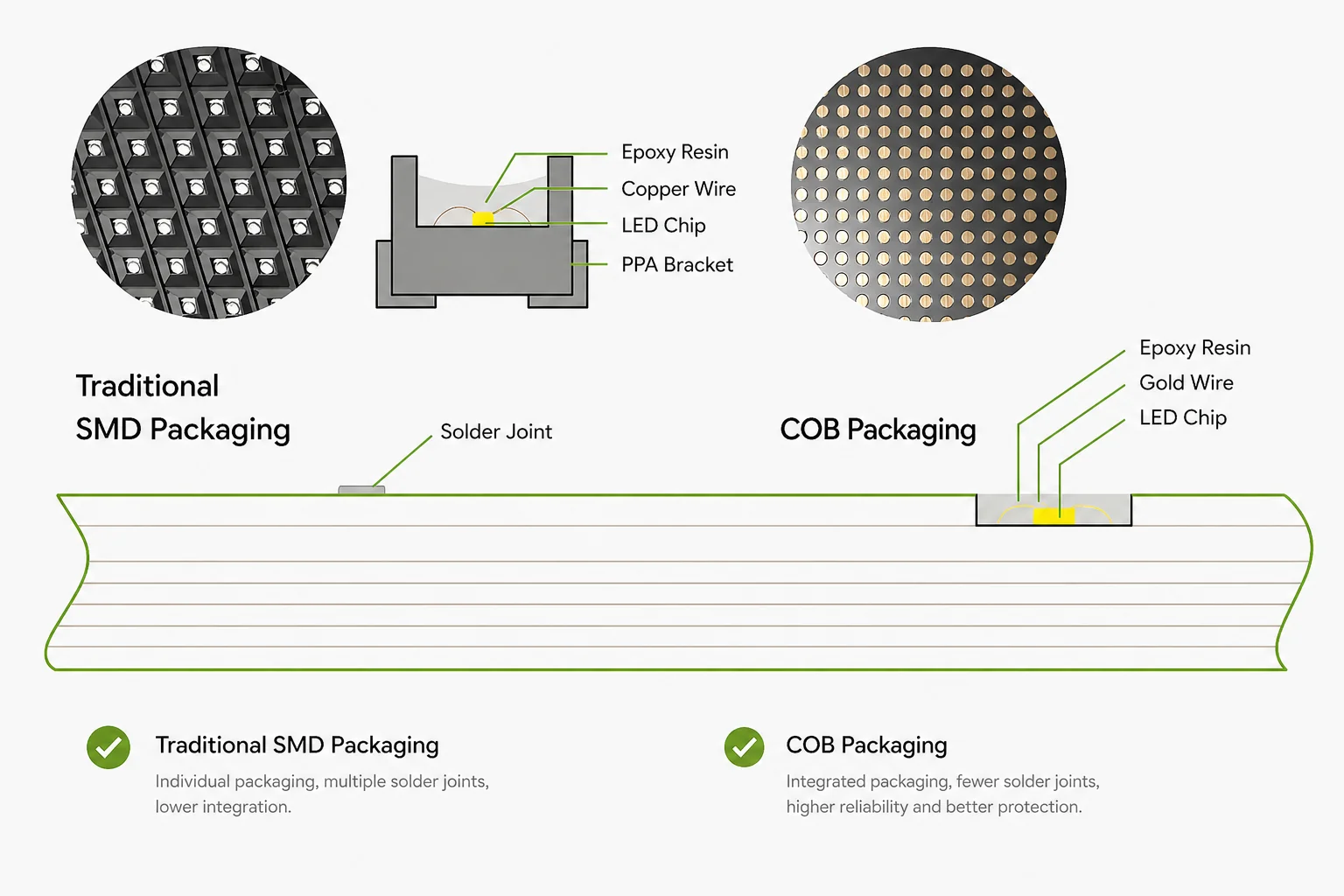
Image Source: VMXVisual
If you sliced through both and looked at the cross section, SMD would show a row of raised boxes sitting on the board. COB would show a flat, continuous surface with chips embedded underneath it.
What that difference enables
A sealed, flush surface with chips packed tightly together changes several things at once.
Pixel pitch can go much finer, so people can sit or stand closer to a COB screen before pixels become visible. On large video walls built from multiple modules, the seams between them are harder to spot because there’s less gap for light to scatter through.
Blacks come out deeper and contrast improves and because the surface is flat rather than made of raised components, there’s less glare under overhead lighting.

Caption: A comparison of displays with SMDActive LED (left) and COB (right)
Image Source: VCoreLED
COB vs SMD Active LED Displays
| Features | COB (Chip-on-Board) | SMD (Surface-Mount Device) |
|---|---|---|
| Design | Chips mounted directly on PCB, sealed under resin | Pre-packaged diodes soldered onto PCB surface |
| Pixel Pitch | Finer pitches (sub-1mm–1.5mm) | Coarser pitches (typically 1.2mm+) |
| Light Output | Softer, more diffused, wider viewing angle | Brighter, more directional output |
| Durability | More rugged and resistant to moisture/impact | More prone to dead pixels and dust damage |
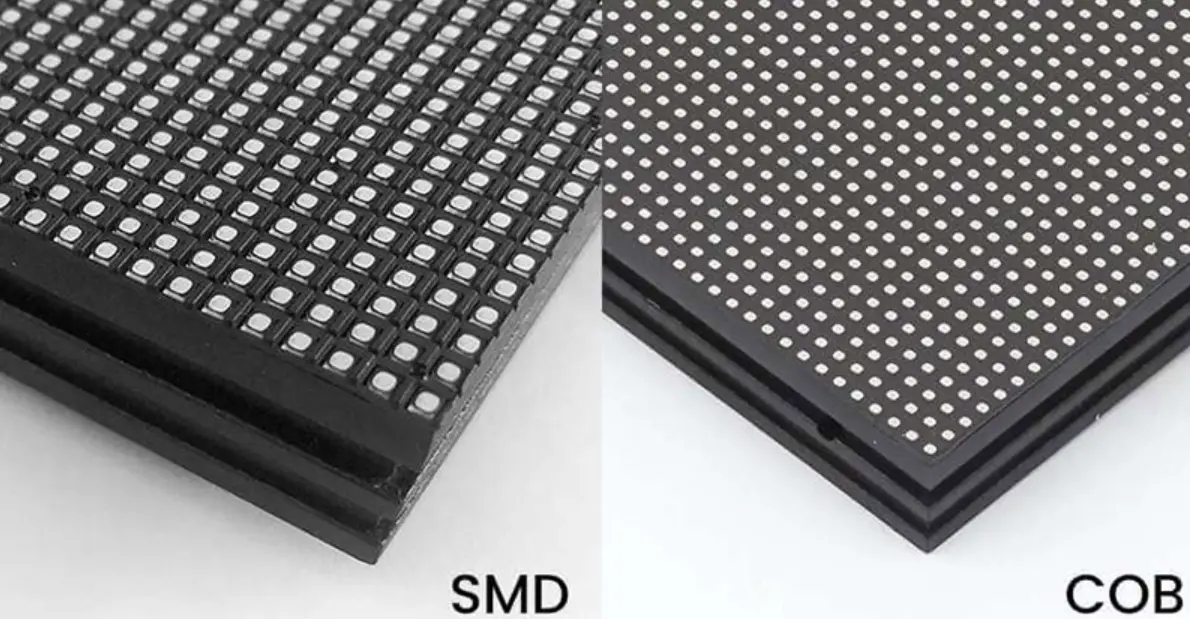
Image Source: OneDisplayGroup
Viewing angles are wider too. A COB display holds its colour and brightness reasonably well even when you’re looking at it from well off to the side, which matters in a boardroom where not everyone gets to sit facing the screen straight on.
Physically, the sealed layer protects the chips from dust, moisture and knocks in a way exposed SMD packages can’t match. A number of COB panels are also designed so technicians can service them from the front, which is a real advantage on a display that’s been built into a wall with no rear access. And because COB doesn’t depend on bulky individual packages, it can be shaped into formats SMD struggles with.
Where the difference shows up for users
Take a boardroom that seats fourteen people around a long table. On an SMD wall, the people at the far end squint at anything smaller than a title slide and colours shift slightly for anyone sitting off to the side. Put COB in the same room and both problems mostly disappear, because the pitch is finer and the viewing angle is wider.
A lobby video wall is a different test. Stitch together six SMD modules and, up close, you can usually see where one tile ends and the next begins, especially on a bright solid colour. COB hides those seams far better, so a brand video reads as one image instead of a grid.
Where COB Active LED technology fits best
Boardrooms, briefing centres, experience centres, lobbies and auditoriums are where COB earns its price. These are rooms where people sit close, where the display is used the most (detailed content, wide viewing angles, close inspection) and where a soft or gridded image gets noticed.
SMD is the right call in a lot of other rooms. A digital signage screen in a corridor, viewed in passing from ten feet away, doesn’t need COB’s pixel density and there’s no reason to pay for it. Budget matters too. If a project has ten screens to fit and a fixed number to spend, SMD across the board can beat a compromise where COB gets specified somewhere it isn’t needed.
Reliability, maintenance and lifecycle value
Because the chips sit under a sealed surface rather than out in the open, COB panels generally suffer less pixel damage from everyday wear, dust and moisture than SMD panels do. Front access servicing adds to this. A technician can pull and replace a module from the front of a built in wall without needing to get behind it, which shortens downtime and avoids disturbing the surrounding installation.
It’s worth resisting the temptation to compare COB and SMD purely on purchase price. A fuller picture includes acquisition cost, how durable the panel is, how often it’s likely to need attention, how easy that attention is to give it and how many years of service you can reasonably expect. A display that costs more to buy but needs very little intervention over ten years can end up cheaper and far less disruptive, than one that’s cheaper upfront but needs frequent fixes.
How organisations should choose
Start with viewing distance, since it does most of the work in this decision. Under about six feet, COB’s finer pitch is usually worth paying for. Past fifteen feet or so, most viewers can’t tell the difference between COB and a well specified SMD panel.
| Application | Winner | Why It Fits Best |
|---|---|---|
| Indoor Corporate & Control Rooms | COB | Seamless surface reduces eye strain and eliminates graininess at close viewing distances. |
| Outdoor Billboards & Large Venues | SMD | Cost-effective for massive scales and delivers the high brightness needed to battle direct sunlight. |
| Virtual Production & XR Stages | COB | Offers wider viewing angles and eliminates the camera moiré effect distortion. |
| Retail & Commercial Signage | SMD | Provides the best balance of budget, brightness, and easy maintenance for standard viewing distances. |
From there, check what else the room is asking for. A control room full of dense dashboards needs the pixel density regardless of distance. A lobby wall built from multiple modules benefits from COB’s seamless look even if people mostly view it from across the room. A corridor screen showing rotating announcements rarely needs either.
Budgets and product lifecycles should settle it from there. How much servicing the display is likely to need over the years it’s expected to run and how disruptive that servicing will be given where it’s mounted.
Conclusion
COB Active LED display technology is expected to keep gaining ground in the enterprise display space over the coming years. The combination of fine pixel pitch, seamless large format visuals, stronger surface protection and steadily improving reliability suits premium corporate environments particularly well and as the technology becomes more accessible, we’re seeing more organisations specify it by default rather than treat it as a premium add on.
SMD and COB technologies both do their job well. The mistake is picking one out of habit, or because it’s the newer name, rather than checking what the room actually needs.
FAQs
Not quite. SMD mounts individually packaged LEDs onto a module, while COB mounts bare chips directly onto the board and seals them under one protective layer. The two are built differently and that difference is what drives most of the practical gap between them.
That depends on the exact pixel pitch of the panel in question, since COB is available across a range of pitches. In general it supports closer viewing than comparable SMD panels because the chips are packed more tightly. Check the specific product’s pitch rating for an accurate distance
In most cases, yes. The sealed surface protects the chips from dust and moisture better than exposed SMD packages and front access servicing makes any maintenance that is required quicker to carry out.
No. It remains a solid, cost effective choice for longer viewing distances and less demanding spaces and plenty of installations don’t need what COB offers.
Viewing distance tends to matter most. Rooms with close, detail heavy viewing generally suit COB, while longer sightlines and tighter budgets often suit SMD just as well.