




Enhance Business Agility with Hybrid Collaboration Rooms
Hybrid work is permanent. The rooms where in-office and remote teams meet every day need to give both sides an equal experience.
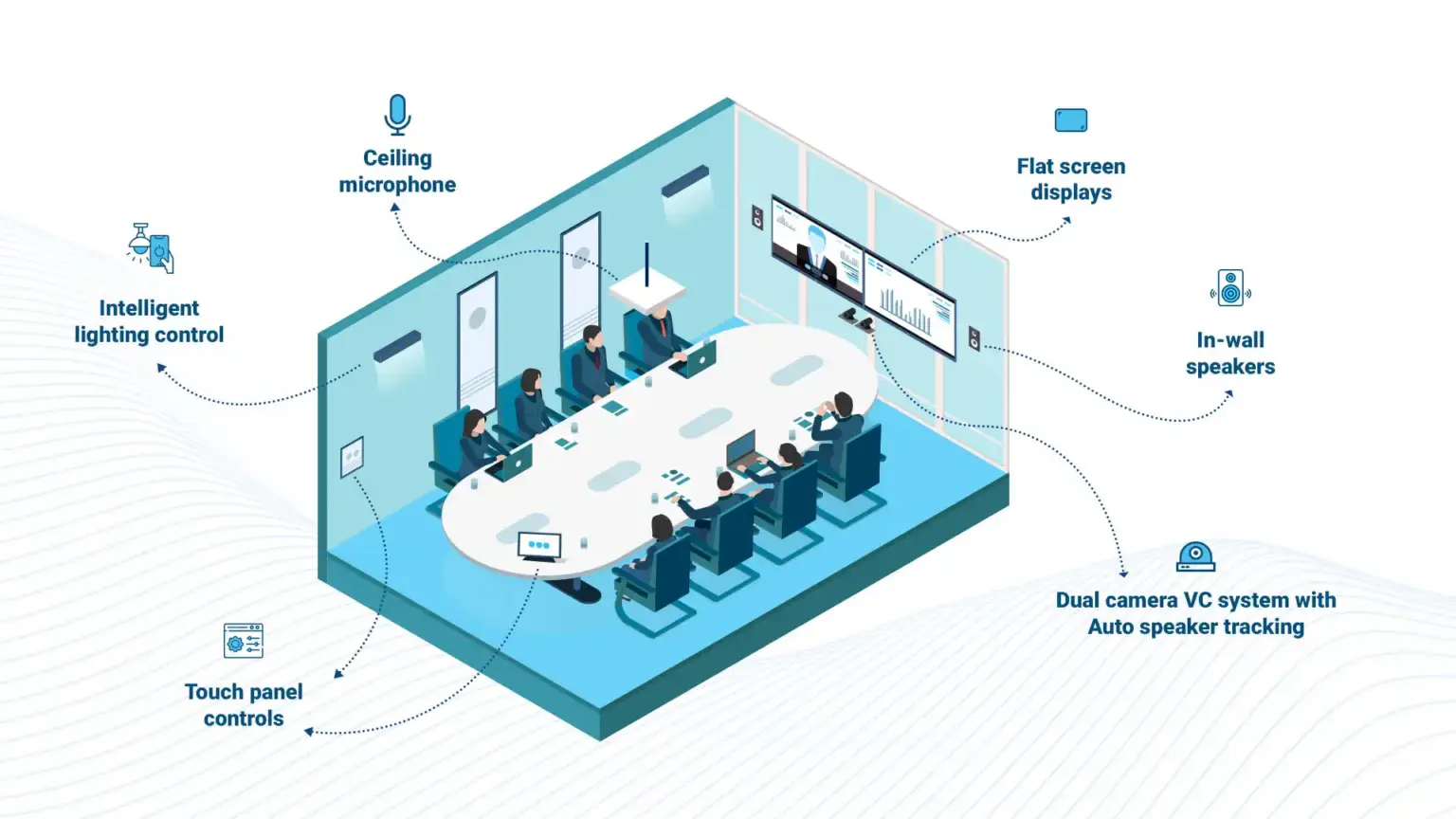
That means intelligent cameras that frame whoever is speaking, audio that captures every voice regardless of where someone sits, displays that make remote participants feel present and a room layout that encourages natural interaction between both audiences. We design hybrid rooms where meeting equity is built into the architecture, not bolted on afterwards.
What Meeting Equity Looks Like in Practice
Meeting equity means remote participants have the same quality of experience as those in the room. They see individual faces, hear every voice, read body language and participate naturally. Achieving this requires deliberate design choices in camera placement, microphone coverage, display positioning and room layout. When these elements work together, hybrid meetings feel like everyone is in the same space.
Intelligent Multi-Camera Framing
AI-powered cameras automatically frame whoever is speaking and provide gallery views of individual participants. Remote attendees see faces and expressions rather than a wide shot of a conference table.
Remote Presence at Eye Level
Remote participants displayed at eye level on a screen large enough to feel present. Positioned so in-room attendees naturally look toward both the room and the remote colleagues during discussion.
Multi-Platform, One Room
BYOM design lets the room work with Teams, Zoom, Webex and Google Meet without reconfiguration. The room’s cameras, microphones and displays are available to whatever platform the meeting uses.
Even Audio Coverage for Everyone
Ceiling arrays capture every voice evenly regardless of seating position. Beam-tracking technology follows the active speaker automatically. Remote participants hear the full conversation clearly.
Key Features of Actis Hybrid Collaboration Rooms
Meeting Equity by Design
AI Speaker Tracking & Framing
Cameras that automatically frame whoever is speaking, switch between speakers naturally and provide gallery views of individual participants. Remote attendees see faces and expressions, not a wide shot of a table.
Distributed Ceiling Microphones
Arrays that capture every voice evenly regardless of seating position. No dead spots, no dominant positions, no need to lean toward a speakerphone. Beam-tracking technology follows the active speaker automatically.
Prominent Remote Display
Remote participants shown on a display at eye level, large enough to feel present in the conversation. Positioned so in-room attendees naturally look toward both the room and the screen during discussion.
Room Layout That Works for Both Audiences
Seating and display placement designed so in-room attendees naturally face both the room and the remote participants. The camera is positioned at conversational eye level, not mounted on a ceiling or low on a wall.
AI-Ready Audio Quality
Microphone and DSP quality optimised for AI-powered transcription, meeting summaries and action item extraction. Tools like Microsoft Copilot and Zoom AI Companion depend on clean audio to generate accurate, usable output.
BYOM / Multi-Platform Ready
Rooms that work with Teams, Zoom, Webex and Google Meet without reconfiguration. Bring your own meeting: plug in a laptop and the room’s cameras, microphones and displays are available instantly on any platform.
Organisations Where Hybrid Is the Norm
If the quality of your meeting space reflects on the quality of your organisation, these solutions are for you.
Enterprises with hybrid policies
IT & ITES /
GCCs
Global
organisations
Any office with remote participants
Trusted by
AV, collaboration and lighting infrastructure for leading organisations
Actis FAQs
These rooms combine smart AV tools such as auto-framing cameras, digital whiteboards and echo-canceling audio, with platform-agnostic conferencing systems. Modern hybrid meeting spaces create a balanced, inclusive experience where remote attendees can see, hear and contribute as effectively as those physically present.
Hybrid rooms promote seamless teamwork across geographies, reduce travel costs and improve productivity. Hybrid meeting room solutions support diverse workflows including brainstorming, decision-making and client engagement, ensuring consistency in communication quality and fostering a more agile and inclusive workplace environment.
Yes, hybrid collaboration setups are highly scalable. Whether for a small huddle space or a large boardroom, the AV design can be tailored with appropriate camera angles, speaker coverage, display configurations and collaboration tools to suit the room’s dimensions and intended use, creating an effective hybrid workroom setup.
A regular meeting room may have a camera and a screen. A hybrid room is specifically designed so remote participants see individual faces, hear every voice clearly and can participate naturally in the conversation. The camera, audio and display design all prioritise meeting equity between in-room and remote attendees.
Meeting equity means remote participants have the same quality of experience as those in the room. They can see faces, hear every voice, read body language and participate in discussions without feeling like outsiders watching through a window. It requires deliberate design choices in camera placement, microphone coverage and display positioning.
Often, yes. We assess existing rooms and recommend targeted upgrades to cameras, microphones, displays and room layout that significantly improve the hybrid experience. A full rebuild is not always necessary. Sometimes a better camera and ceiling microphones transform the room entirely.
Yes. We design for BYOM so rooms work with Teams, Zoom, Webex and Google Meet without reconfiguration. The room’s AV infrastructure is platform-agnostic. Whoever starts the meeting chooses the platform, and the room adapts.