


From hybrid workplaces to immersive learning environments and mission-critical command centres, specialised AV solutions are transforming how industries operate and engage
In today’s hyper-connected landscape, AV technology isn’t just about adding screens or microphones. It’s about weaving together a network of integrated, intelligent systems that understand and respond to the unique needs of each industry. Its impacts also go far beyond the ubiquitous meeting/conference boardroom – to customised spaces that enhance productivity in unusual or perhaps industry-specific collaborative scenarios.
Yet, the full potential of AV technology is only realised when it is customised to fit the specific requirements of its environment. That’s where specialised AV comes in. These solutions go beyond plug-and-play setups to address the complexities of workflows, compliance standards, spatial constraints and user behaviours. Here are five sectors where specialised AV systems are creating meaningful change, along with insights into how they evolve and what they accomplish.
Corporate & Financial Services: Building Agile, Hybrid Workspaces
The modern corporate workspace has become a dynamic blend of physical and virtual interactions. Financial institutions and global enterprises, in particular, operate across time zones and demand precision, security and adaptability from their technology infrastructure. In such settings, AV solutions must seamlessly facilitate collaboration between in-office staff and remote teams, ensure continuity across meetings of different scales and maintain an enterprise-grade standard of performance.

Consider the approach taken in a leading reinsurance firm’s headquarters, where a variety of collaboration and event spaces were designed to cater to diverse use cases. A large hall was designed to serve as both a 50-60 seater venue and three 15-seater breakout rooms, each equipped with intelligent displays and video conferencing tools. In parallel, training and VC spaces were designed to host up to 25 participants, each with reconfigurable layouts and support for wireless sharing. The largest gathering space, a 500 to 800-seat auditorium, enabled two-way conferencing for enterprise-wide communication events.
What distinguishes specialised AV in this domain is its ability to enhance not just communication, but strategic operations: reducing time-to-decision, improving stakeholder alignment and supporting a modern, agile corporate culture.
Government & Command Centres: Supporting Mission-Critical Decision Making
In government and public sector organisations, AV technology often underpins mission-critical decision-making. Whether it’s a national control room, an agriculture monitoring facility, or an emergency operations centre, these spaces demand AV systems that deliver clarity, uptime and interoperability with a wide range of data sources and command protocols. In March 2020, just before the lockdown was announced in full swing, we were tasked by BCG to set up a War Room in Delhi for the Ministry of Health within 24 hours. Working alongside multiple contractors, our NCR team designed, installed and commissioned the facility, completing testing and training by 11 PM the next day, well ahead of schedule.

Unlike conventional meeting rooms, command centres operate under unique pressures: the need for uninterrupted visualisation, real-time data interpretation and secure communication across multiple endpoints. Visual infrastructure often includes high-resolution LED walls capable of displaying multiple data feeds simultaneously, while audio systems must handle both clarity and discretion in high-pressure contexts.
A compelling example of this is the AV deployment at the headquarters of a major Indian fertiliser cooperative, where boardrooms and committee rooms were equipped with high-precision PTZ cameras and Bose digital signal processors to ensure intelligibility and control. The 200-seater auditorium featured a massive 20ft x 7ft 4K touchscreen LED wall to display real-time dashboards, video feeds and presentations during critical stakeholder meetings. These integrations allow senior officials to move seamlessly from strategic planning to field-level coordination, all within the same ecosystem.
Specialised AV in such contexts ensures that critical information is delivered accurately and securely, empowering governments and public bodies to make faster, more informed decisions.
Education & EdTech: Shaping Immersive, Multi-Modal Learning Environments
Few sectors have embraced AV transformation as deeply as education. As teaching shifts from traditional lecture formats to blended and hybrid models, AV systems are being used to create more engaging, accessible and responsive learning environments.
Modern classrooms are now equipped with interactive whiteboards, ceiling microphones, PTZ cameras and integrated control systems that enable educators to transition seamlessly between in-person and virtual instruction. Auditoriums double up as live-streaming studios, while campus-wide networks distribute announcements, content and ambient sound.
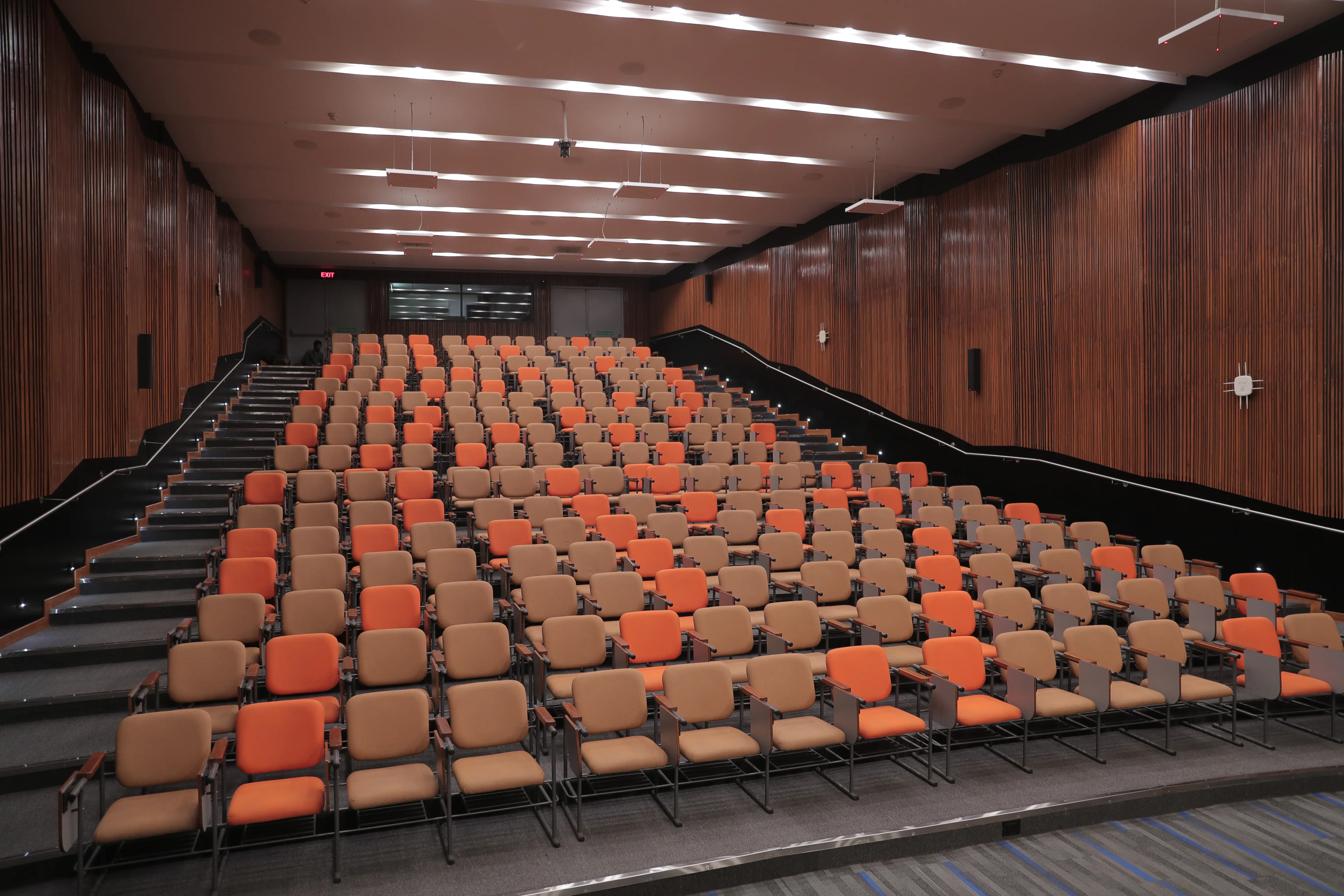
In one prominent urban university, for example, a sports and event hall was transformed into a 1,000-seater multipurpose space using retractable bleachers, high-lumen laser projectors and dynamic stage lighting. Academic buildings housed classrooms of various sizes, all retrofitted with AV tools that respected the heritage architecture while bringing them into the digital age. Audio systems were networked across the Student Activity Centre to deliver real-time announcements and background music to different functional zones.
This evolution isn’t just about making education digital; it’s about making it adaptive. Specialised AV empowers institutions to cater to students with diverse needs, support multiple teaching formats, and prepare for future challenges such as remote examinations, asynchronous learning and VR-based labs.
Hospitality: Engineering Atmosphere and Brand Impact
In high-end hospitality and brand experience spaces, AV is less about information and more about emotion. The goal here is to craft immersive, memorable environments that align with brand identity and guest expectations, without compromising aesthetics.
Specialised AV solutions in this industry focus on discreet integration, automation and control. Projection systems are hidden within ceilings, speakers blend into décor and lighting responds to the mood and type of event. The technology must be both invisible and impeccable.
One luxury hotel in Mumbai showcases how this balance is achieved. Motorised screens were embedded on opposite walls of a grand banquet room, ensuring unobstructed views from all angles. Retractable ceiling projectors delivered crisp visuals at 4,000 lumens, yet disappeared completely when not in use. Touch-based control panels managed not just the AV systems but also lighting and environmental settings, ensuring seamless transitions between corporate functions and social gatherings.
In experience centres, meanwhile, AV becomes a storytelling tool. Through interactive displays, ambient soundscapes and responsive lighting, brands can immerse visitors in narratives that go beyond static exhibitions.
In both contexts, specialised AV is about orchestration. It allows venues to switch modes, adapt experiences and offer guests a sense of effortlessness, all powered by careful engineering and spatial design.
AV as Infrastructure for the Modern Organisation: Closing Thoughts
AV is no longer a bolt-on; it’s a critical part of operational infrastructure, like networking or energy management. But for it to deliver real value, it must be specialised, designed with the end-user, the space and the industry context in mind.
From government operations centres to medical colleges and global boardrooms, the most successful AV deployments are those that speak the language of their environment. They go beyond utility to create clarity, fluidity and connection.
Our experience across these industries has shown us that specialised AV isn’t just about technology, it’s about transformation. By designing with intent and deploying with precision, AV can elevate how organisations teach, govern, collaborate, care and engage.
FAQ’s
The blog identifies Corporate & Financial Services, Government & Command Centres, Education & EdTech, and Hospitality as the core sectors. It explains how tailored AV systems enhance collaboration, mission-critical operations, immersive learning, and guest experiences.
In these sectors, AV supports agile hybrid workspaces, global collaboration and quick decision-making. For example, a large auditorium was reconfigured into breakout spaces with VC and wireless sharing to support time-sensitive workflows.
These environments demand mission-critical clarity, high uptime, and integration with multiple data sources. AV systems must support real-time dashboards, multi-input content and rapid response — far beyond typical meeting rooms.
AV enables hybrid classrooms, interactive learning, live streaming and multipurpose venues. Schools and campuses now use PTZ cameras, ceiling mics and networked AV systems to support diverse formats like in-person, online, and mixed modes.
Here, AV is about ambiance, storytelling and seamless automation. Luxury hotels embed projectors, LED walls, immersive sound and lighting control to support events and guest stays—technology that becomes invisible while enriching the stay.