


Interactive projectors and whiteboard, which support multi-touch finger gestures and interactive pens, have been increasingly popular in classroom AV solution among educators in recent years. With touch interactive functions and PC-free annotations, teachers and students can easily transform any surface into an interactive environment.
Many teachers have found creative ways of using interactive projectors and whiteboards to facilitate discovery-based learning. Here are some ideas on getting creative with interactive projectors and whiteboard and whiteboard in classrooms to make the learning experience a whole lot more fun for students:
Thinking-based learning
With an interactive projector, you can illustrate the growth cycle of plants, animals and human beings using video clips available on the Internet to help students learn better. Teachers can pause video clips of speeches and let students draw thought bubbles to illustrate what the speaker’s audience might be thinking.
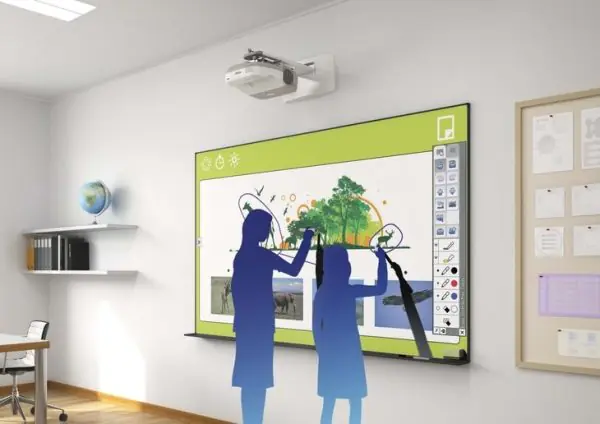
With interactive whiteboards and projectors, annotations along with the images can be captured and saved for the students at the end of the lesson.
Easy brainstorming sessions
An interactive projector can also convert any surface into an interactive whiteboard without the need for a physical screen, letting students take down their ideas during a brainstorming session. With interactive projectors and whiteboards, these ideas can be captured as a PDF file and shared with students, parents or posted on the class website.
Interactive learning experiences
Learning is a lot more fun and engaging through interactive exercises such as matching games. This can range from getting pupils to link words with pictures of animals to matching famous quotes with their sources.
Introduce virtual tours with VR
Many places with a historical and cultural value offer virtual tours online, which can be shown to students using interactive projectors. With interactive projectors and whiteboards, students and teachers can mark out features of a historical site for an interactive learning experience.
Simplifying complex problems
Robotics is a great way to instil interest in science and technology. With an interactive projector and a document camera, teachers can easily demonstrate how to use tools to understand and eventually design robots or robotic projects, so that the whole class can easily see. After designing their robots, students can share their designs with their classmates. This combination of an interactive projector and a document camera can be used to simplify and teach complex problems and lessons.
FAQ’s
AV solutions have quietly become one of the most powerful tools for transforming classroom learning—not just by making things look and sound better, but by fundamentally changing how students engage with information. It’s not about replacing teachers or traditional methods; it’s about enriching them with technology that makes learning more interactive, immersive and inclusive.
Take displays, for example. A high-quality interactive display or smart board doesn’t just show slides—it becomes a collaborative tool. Teachers can annotate, zoom in, pull up videos, or even bring in live data on the fly. Students can come up to the board and interact with content themselves, which turns a passive lecture into a hands-on experience. It’s especially powerful in subjects like science, geography, or math, where visualising concepts makes all the difference.
Audio plays a surprisingly big role too. In larger or acoustically challenging classrooms, students sitting at the back often miss out—either because the teacher isn’t clearly heard or background noise gets in the way. With even basic audio reinforcement systems or ceiling microphones, every student can hear equally well, which directly improves comprehension and participation.
Then there’s video conferencing and remote collaboration. AV systems allow schools to connect classrooms across cities—or even continents—for guest lectures, collaborative projects, or hybrid learning setups. Students get exposure to new perspectives and it prepares them for the kind of tech-driven communication they’ll encounter in the real world.
Recording and streaming lessons is another game changer. Missed a class? Need to revisit a tricky concept? With AV capture systems in place, lessons can be archived and accessed on-demand, supporting both students who need more time and those who learn at different paces.
AV also makes classrooms more inclusive. From assistive listening systems for students with hearing impairments to real-time captioning and multi-language support, the right tech ensures that no one is left behind. It’s not just about having tech for tech’s sake—it’s about designing AV systems that genuinely support teaching and learning goals. When done right, the result is a classroom that’s not only smarter, but more dynamic, engaging and accessible for everyone.
They allow touch-based interaction, real-time annotations, and multimedia integration. Students actively engage with content, enhancing understanding and retention. Teachers can deliver lessons dynamically and innovatively.
Yes, they combine projection, digital annotation, and collaborative features. Traditional boards become more engaging, interactive, and versatile. Classrooms benefit from modernized learning environments.
Remote students can view, interact, and participate in lessons in real-time. Integration with video conferencing and cloud platforms ensures seamless engagement. Hybrid learning becomes inclusive and productive.
Evaluate classroom size, technology compatibility, and user training. Proper placement and system integration maximize effectiveness. Selecting the right tools ensures better engagement and learning outcomes.
Interactive projectors and whiteboards encourage collaboration, creativity, and active learning. Students respond, annotate, and interact confidently. Classrooms become more engaging, inclusive, and results-driven.