


Gone is the era where teaching was limited to only textbooks and journals. Technology has trickled into every aspect of our life including the way education is being imparted. AV Technology in the classroom is no longer a marvel of technology. Today, schools are opting for classroom AV solutions for a wholesome and interactive learning experience.
An essential element of modern classroom AV solutions is the projector. It ensures that every member of the class has visibility to the topics being discussed. To add to this, today’s interactive projectors also moonlight as an interesting tool to hold and maintain student’s attention in classrooms. Buying a new projector for a classroom can be a mind-boggling experience, especially for less tech-savvy educators who have to make sense of an alphabet soup of acronyms and technical terms.
Our easy projector buying guide will help you with common queries regarding terminology, features and other important aspects to consider while choosing one for your classroom.
#1. Check lumens rating
Projectors come in a range of brightness measured in lumens. The brighter the projector, the higher the lumen rating. Needless to say, higher lumens means higher pricing. When buying a projector, ensure to look for two types if lumen specifications: lumens for colour brightness and lumens for white brightness. The amount of brightness needed for your classroom is determined by the room’s ambient light condition. For classrooms, conference rooms or boardrooms with controlled lighting environments, opt for a projector with a minimum brightness of 2,500 lumens.
#2. Check for interactivity options
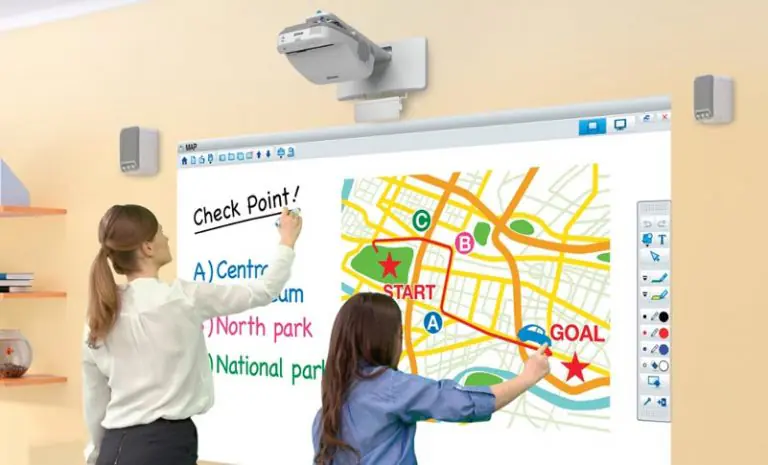
Projectors come in a range of brightness measured in lumens. The These days, projectors are more than just devices that project images onto a projection screen. Leading projectors in the market sport smart, interactivity capabilities, such as touch gestures and interactive pens for annotations. This opens up exciting teaching and learning opportunities.
Interactive whiteboards are slowly being replaced with interactive projectors that require much lesser space to install. User scroll, press, tap, pinch in/out and rotate images using your fingers, that too without a PC. Both teachers and students can also annotate on the on-screen images with their fingers or interactive pens. This encourages student-and-teacher interaction on the same screen. Interactive projectors will let you connect multiple PCs, tablets and smartphones over a wireless network to foster collaboration among users, who can simultaneously annotate on their individual devices.
#3. Throw distance
A projector’s throw distance is the distance between the projector and the image on the screen. Long throw projectors are required for projecting large screens, while short throw projectors are ideal for smaller rooms such as a classroom and boardroom to reduce shadows and eye glare. Short-throw projection generally refers to a distance between 3-8 ft. away from the projector to the screen to project an 80” diagonal screen (roughly).
Ultra-short throw projectors are usually installed on the wall or the ceiling, completely eliminating shadows and eye glare. Ultra-short-throw projection refers to a distance between 0-4 ft. from the projector to the screen.
#4. Check for ease-of-use and multiple connectivity options
Numerous projectors support multiple inputs sources. However, you should buy a projector that has input provisions for your media player or content sources. Apart from supporting wireless projections via a computer or smart device, today’s interactive projectors also let connect high-definition sources such as Blu-ray players or Apple TV via HDMI ports. Both the students and teachers should find it easy to get the projector up and running. For hassle-free projection, you should look for projectors that feature quick setup for easy and quick projection.