


Walk into almost any modern office and you will probably find screens glowing in meeting rooms, cameras sitting above displays, and control panels on the walls
There are client presentations, town halls, workshops, internal reviews and daily stand ups. Without dependable AV, none of it flows the way it should.
Yet many organisations still treat AV as a one-time installation. Until you start noticing the cracks: a cable loosens behind a rack, a camera stops tracking correctly, or a display that does not turn on. You get the idea, you’ve probably experienced it.
Wouldn’t you agree that when that happens, it disrupts work?
This is why AV support services for business and managed AV services workplace strategies are not optional. They are a part of operational discipline that keeps your existing AV and collaboration infrastructure running smoothly.
Let us explore how, and why.
Why AV Support Matters in Today’s Workplace
The workplace is no longer confined to one physical space. Meetings include remote participants, shared content, live collaboration and recordings for later reference. Someone joins from home. Someone else from another country. A third shares files from a recently updated laptop.
It’s an unspoken expectation: everything should work.
When it does not, productivity drops, and the momentum fades.
Increasingly organisations are treating their AV systems as mission-critical infrastructure. They sit alongside networking, software and security as essential layers of business continuity. They shape first impressions with clients, influence internal collaboration quality and affect morale more than we realise.
Managed support ensures that this infrastructure stays aligned with how teams actually operate.
What Are AV Support and Managed Services?
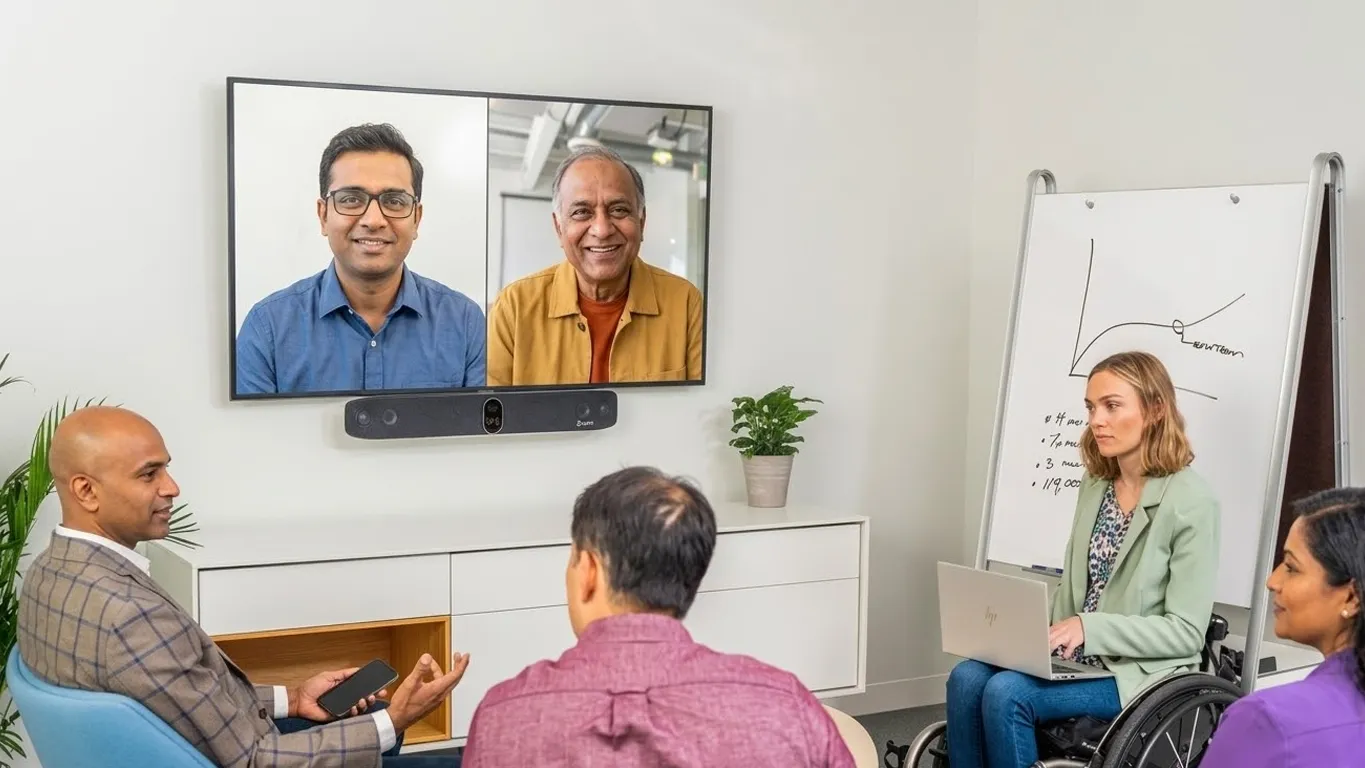
Reactive support is a thing of the past. Now you can’t afford to wait until things go wrong. Managed services assume that issues will eventually occur and work to detect them early. That shift alone changes everything.
The uptime of your AV systems has therefore become the key metric for organisations to monitor, and managed service providers can help them maximise this.
Typically, AV support services include the following:
- 24×7 help desk access with rapid response
- Remote monitoring of system health and device status
- Preventative maintenance scheduling
- On-site technical assistance when needed
- Integration with ITSM platforms for streamlined ticket management
- Firmware updates and system optimisation
- Performance audits and lifecycle planning
Let’s look at its numerous benefits …
Benefit 1: Enhanced System Performance and Reliability
Imagine a senior executive talking about the company’s goals this year when the microphone stops functioning. People look at each other. Someone taps the cable. There are hushed murmurs discussing what to do.
Well, if the company had structured AV support, this situation wouldn’t have occurred.
When systems are monitored in a timely manner, irregular behaviour is noticed early. They are visible to a managed service team long before they become visible to employees.
Instead of reacting to failure, AV issues are fixed proactively.
Benefit 2: Proactive Issue Resolution and Reduced Downtime
Preventative maintenance reduces the chances of downtime from occurring significantly.
Connections are checked before they loosen, filters are cleaned before airflow becomes restricted, software updates are done on time and devices nearing end of life are flagged well before they create embarrassment in a critical meeting. Parts like projector bulbs can be ordered and replaced ahead of time, so meetings keep ticking along.
With managed AV services workplace models in place, many issues never require someone physically entering the room. Remote diagnostics solve problems quietly.
Benefit 3: Seamless AV Integration
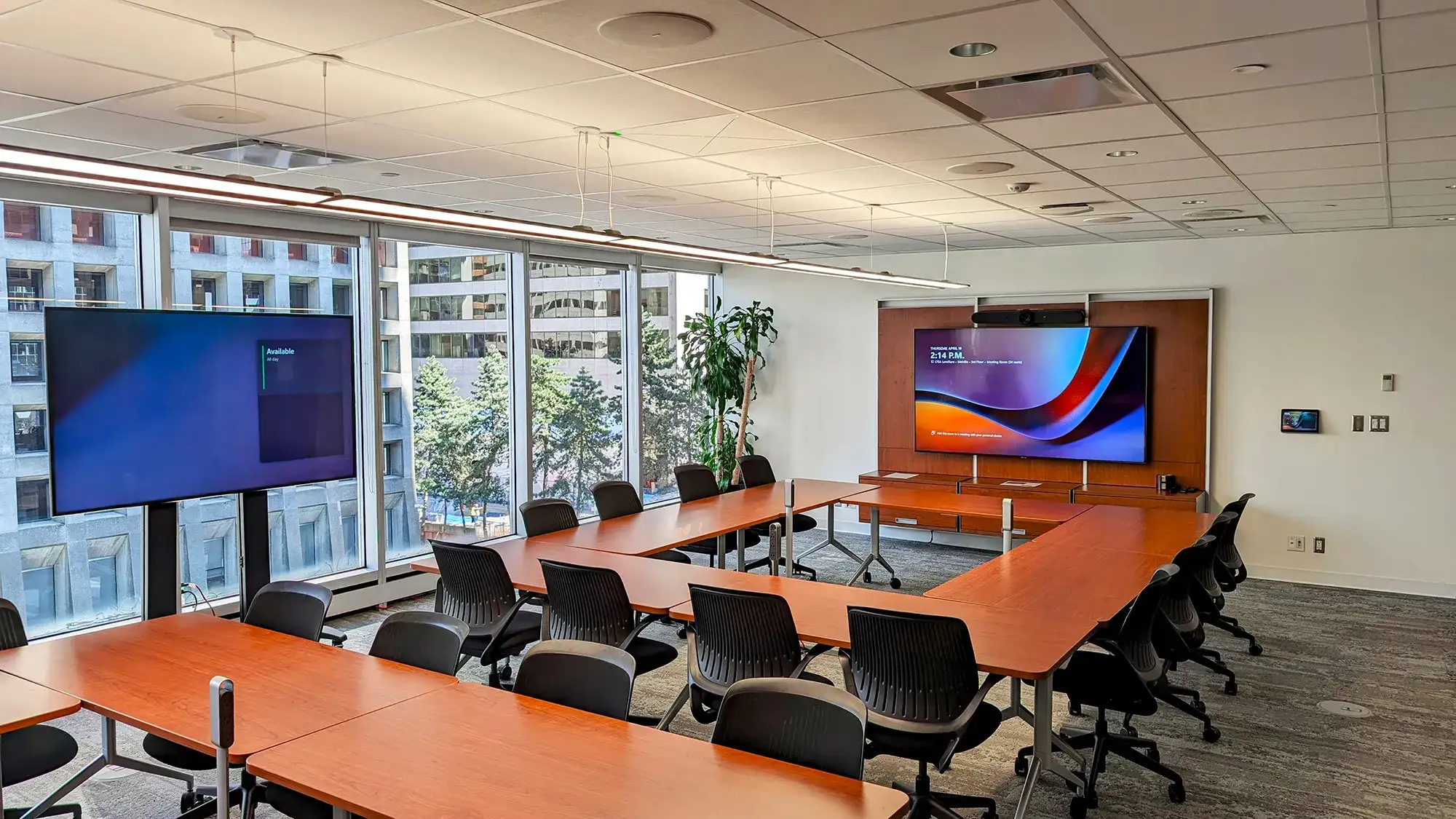
One thing that many don’t foresee is that offices don’t always stay the same.
Sometimes the layouts shift, maybe the collaboration platforms change, new security requirements emerge, a new office opens in a different city. This is especially true for larger organisations.
AV systems need to adapt to all of that without creating friction.
Support teams make sure devices align with network architecture, room booking systems and corporate policies. Multi channel connectivity is configured correctly from the beginning. Updates are properly tested before deployment. Standards are documented and replicated.
Without this oversight, organisations may end up with isolated rooms that behave differently from one another. With managed support, there’s consistency.
Benefit 4: Better Collaboration and Communication
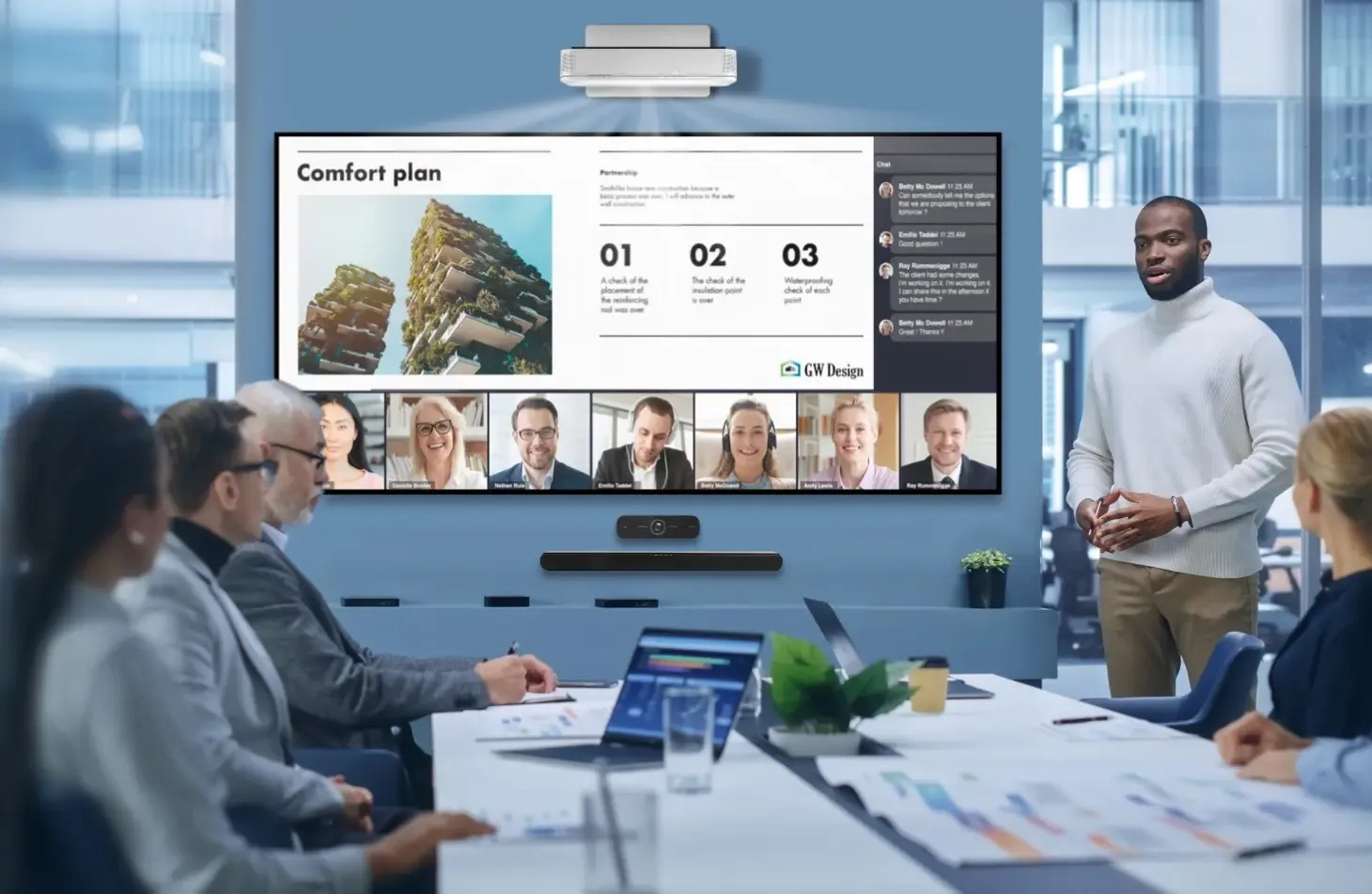
Today’s workplaces demand quick decisions, good communication and smooth collaboration among teams.
Imagine having a talented team of individuals ready to solve a problem and waiting eagerly to contribute only to find that the projector is not working for some reason. They make a call to the concerned team and wait for help to arrive as their enthusiasm fades.
You wouldn’t want your teams to work like this, would you?
Reliable AV has a direct human impact.
Clear audio changes how people engage. Stable video ensures there’s no fatigue. Proper camera framing makes remote participants feel like an actual part of the team.
You won’t even notice it when these are working well. Yet they have an important part to play in every interaction.
Managed services focus on those subtleties. Audio levels are calibrated carefully. Acoustic challenges are addressed early. Care is taken to ensure that video calls remain stable even during high usage periods.It simply makes collaboration feel natural.
And that natural flow is what teams actually need.
Benefit 5: Predictable Costs and Cost Savings
Reactive repair is unpredictable by nature. Something fails. An urgent visit is required. And suddenly, your operations might be exceeding the budget.
Structured AV support changes the financial pattern.
Most managed AV services workplace plans operate on defined monthly or annual agreements. That shifts spending from surprise repair bills to planned operational costs. Forecasting becomes easier. Financial planning becomes steadier.
There are indirect savings as well. It’s a no-brainer: equipment lasts longer when maintained properly. Downtime decreases. Internal teams spend less time trying to solve AV problems.
Over a few years, those incremental savings accumulate and create a stable, reliable work environment.
Benefit 6: Scalable and Flexible Upgrades
A chain is only as strong as its weakest link. So, if your company wants to grow, but your AV planning is not up to the mark, the cracks will start showing sooner or later.
You move into your new office only to find the systems do not match. A hybrid policy expands and existing rooms struggle to keep up. Another collaboration tool is introduced and integration becomes messy.
Managed support provides structure during expansion. New rooms are configured using established templates. Documentation stays centralised. Performance benchmarks are maintained across locations.
Scaling does not have to be chaotic. With the right AV team by your side, it can feel smooth and organised.
Flexibility works the other way too. If teams reduce physical office space or shift meeting styles, systems can be adjusted without dismantling the entire infrastructure.
That adaptability protects long term investment.
Benefit 7: Boosted Productivity and Employee Satisfaction
Frustration with technology builds up subtly.
Technical issues cause delays in meetings, there are issues with the audio mid presentation, colleagues are asked to repeat themselves by remote participants, and so on.
Reliable AV significantly lowers those points of friction.
Issues are detected before they surface through proactive monitoring. Many problems can be fixed with remote troubleshooting in a matter of minutes. Systems remain stable with routine maintenance.
The effects manifest in subtle ways. Meetings begin on schedule. Conversations continue uninterrupted. Workers have faith in the workplace culture. As a result, people perform better when they don’t have to struggle with the tools that are supposed to assist them.
Conclusion
In today’s dynamic workplaces, it is imperative to treat AV systems as mission-critical infrastructure. Managed AV support and services offer several benefits, such as enhanced reliability, fewer downtime, seamless integration, superior communication, predictable costs, scalable growth, and ultimately, a more productive and satisfied workforce. By shifting from reactive fixes to proactive strategies, organizations eliminate friction and future-proof their operations. Don’t let AV glitches get in the way of your success.
FAQ’s
They keep your meeting rooms, collaboration tools and presentation systems running reliably. Instead of reacting to technical failures, you gain proactive monitoring, faster troubleshooting and predictable costs. The result is fewer interruptions and more productive teams.
Through continuous monitoring and preventative maintenance. Small issues are detected early, often resolved remotely before users even notice. That means fewer delayed meetings and less last minute scrambling.
Costs typically depend on the number of rooms, devices and service level required. Many providers offer fixed monthly plans, which help control budgets and eliminate surprise repair expenses. For smaller businesses, this predictability is often more valuable than the price itself.
Yes. Managed AV services are designed to align with your current network, collaboration platforms and IT workflows. Integration with ITSM tools and remote management platforms ensures everything operates within your existing infrastructure.
AV installation is the process of setting up audio-visual systems like displays, speakers, projectors, and control systems in a space.
It includes design, wiring, mounting, configuration, and testing to ensure seamless performance.
AV support refers to ongoing maintenance, troubleshooting, and technical assistance for audio-visual systems.
It ensures smooth operation of equipment, quick issue resolution, and optimal performance in daily use.
AV services include design, installation, integration, and maintenance of audio-visual systems like sound, video, and display solutions.
They also cover technical support, content management, and system upgrades for smooth and efficient AV operations.