


We explain how strategic AV integration enhances decision making, security and long term operational efficiency for government bodies looking to build smarter, more connected infrastructure.
AV systems in government are no longer limited to meeting rooms or ceremonial spaces. They now support real time decision making in command and control centres, enable remote access to justice and education, and act as the visual interface between government and citizens. When designed strategically, AV becomes a foundational layer that connects people, data and processes across administrative boundaries.
This blog outlines how government bodies in India can approach AV integration as a long term infrastructure investment. It explores the strategic role AV plays in governance, the most impactful use cases, the architectural and security considerations unique to public sector environments, and a practical roadmap for deployment and sustained performance.
The evolving role of AV in Indian governance
The expectations placed on government institutions have changed significantly. Citizens expect faster responses, clearer communication and greater accountability. Administrators are required to coordinate across departments, jurisdictions and physical locations, often under time critical conditions. In this environment, AV systems serve as a bridge between information and action.
In governance contexts, AV enables situational awareness. Whether monitoring urban infrastructure, coordinating disaster response or conducting high level reviews, officials depend on accurate visualisation and intelligible audio to assess situations and take informed decisions. AV also supports inclusivity by allowing participation from remote locations, reducing the need for physical travel and expanding access to government services.
Equally important is the role of AV in standardising communication. Consistent meeting experiences, reliable briefing environments and clearly defined workflows reduce friction within government machinery. When AV systems are treated as part of core infrastructure rather than isolated installations, they contribute directly to administrative efficiency and institutional resilience.
High impact government use cases across India
Some of the most visible and valuable AV deployments in India are found in mission critical government environments. These use cases demonstrate how integrated AV systems directly support public outcomes.
Command and control centres are a prime example. National and state level facilities supporting disaster management, law enforcement, transportation and utilities rely on continuous streams of video and data. AV infrastructure enables these inputs to be visualised clearly and dynamically, allowing operators to correlate information and respond rapidly. Reliability and uptime are paramount in such environments, as even brief outages can compromise public safety.
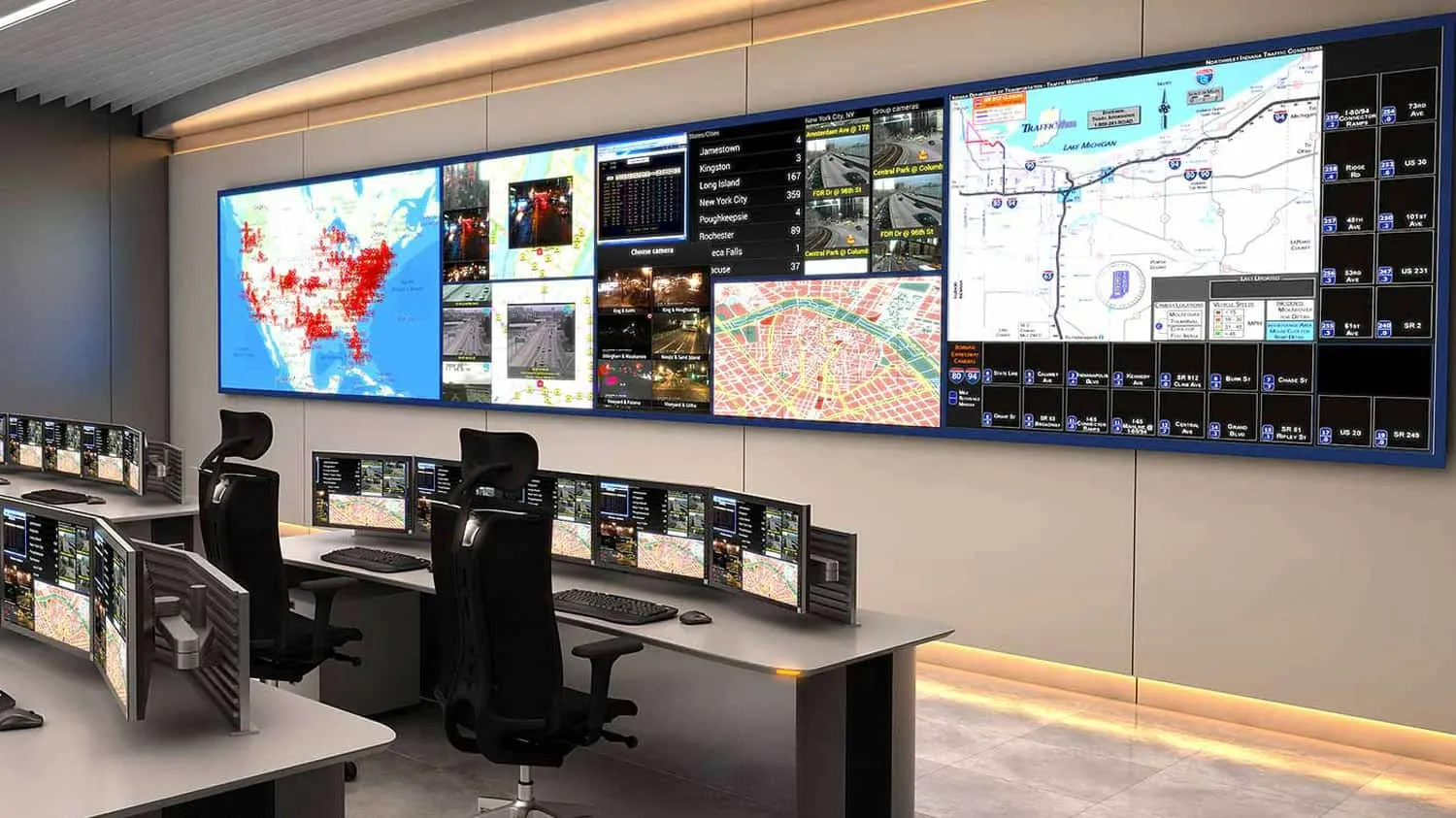
Municipal integrated control rooms developed under the Smart Cities Mission represent another major use case. These centres consolidate feeds from traffic cameras, public transport systems, environmental sensors and citizen grievance platforms. AV systems play a central role in presenting this information in a coherent and actionable format. The result is improved coordination between departments and measurable reductions in response times.
Judicial and administrative spaces have also seen significant change. Virtual courtrooms and remote hearing facilities allow judges, lawyers and witnesses to participate without geographical constraints. AV systems in these environments must deliver high clarity audio, accurate video reproduction and secure recording to maintain the integrity of proceedings.
Public engagement spaces form a final important category. Government information centres, exhibition halls and citizen service kiosks increasingly use interactive displays and digital signage to communicate policies, schemes and real time updates. AV technology helps government bodies present information in a more accessible and engaging manner, strengthening trust and transparency.
Architectural foundations for government AV systems
Successful government AV deployments are built on robust architectural principles that prioritise security, scalability and interoperability. Network centric design has become the standard approach, with audio and video distributed over IP networks rather than through dedicated point to point cabling. This allows systems to expand incrementally and simplifies integration with existing IT infrastructure.
Display and visualisation technologies must be selected based on operational requirements. Control rooms often rely on LED video walls designed for continuous use, while briefing and review rooms may benefit from high resolution displays or projection systems optimised for data rich content. Government bodies should plan for future resolution and bandwidth requirements to avoid premature obsolescence.

Interoperability is another critical consideration. AV systems need to integrate with collaboration platforms, data dashboards and archival systems used by government departments. Open standards and documented APIs reduce dependency on proprietary ecosystems and allow agencies to adapt systems as requirements evolve.
Security considerations are especially pronounced in government environments. Media streams must be encrypted, networks segmented and access tightly controlled through identity management systems. For sensitive applications, edge processing is often preferred, allowing analytics and recording to occur within secure premises rather than in public cloud environments. Redundancy in power and network connectivity ensures continuity during infrastructure failures.
Governance, compliance and procurement realities
AV integration in government is shaped as much by policy and regulation as by technology. Indian government bodies must comply with data protection requirements, cybersecurity guidelines issued by CERT IN and sector specific regulations depending on the nature of operations. These frameworks influence how AV systems are designed, deployed and operated.
Procurement is governed by established public sector norms such as the General Financial Rules and tendering procedures. Technical specifications must be clear, measurable and aligned with operational needs. Many tenders also include local sourcing or Make in India requirements, which affect product selection and vendor eligibility.
Data residency is an increasingly important factor. Recordings of meetings, hearings or operational footage often contain sensitive information. Government agencies must ensure that storage and backup mechanisms comply with national data policies and internal security protocols. In many cases, on premise or government approved data centres are preferred.
Security audits and lifecycle support are now common requirements in AV contracts. Annual maintenance agreements increasingly include provisions for firmware updates, vulnerability assessments and incident response support. These measures help ensure that AV systems remain secure and functional over extended operational lifespans.
A practical roadmap to implementation
Given the complexity of government environments, AV projects benefit from a structured and phased approach. The process begins with a detailed assessment of operational needs, user behaviour and existing infrastructure. This stage helps identify priorities and constraints, ensuring that technology choices are driven by outcomes rather than specifications alone.
Pilot deployments play a crucial role in reducing risk. Implementing a live pilot in a representative environment allows stakeholders to validate performance, usability and integration before scaling. Feedback from pilots often informs refinements that significantly improve system effectiveness.
Once validated, deployments can be scaled across departments or locations. Clear governance structures help manage this phase. Defined roles for IT teams, facilities management, security and the integration partner ensure coordination and accountability. Standardised designs and documentation help maintain consistency across sites.
Training and change management are essential for adoption. Government users range from technical operators to senior officials, each with different requirements. Role based training and clear standard operating procedures enable confident use of systems and reduce reliance on ad hoc support.
Ongoing operations complete the roadmap. Proactive monitoring, preventive maintenance and responsive support ensure reliability. Lifecycle planning that accounts for equipment refresh cycles and evolving requirements helps protect public investment and sustain long term value.
Measuring outcomes and sustaining value
The impact of AV integration in government can be measured through both operational and qualitative indicators. System uptime, response times and usage metrics provide insight into technical performance. Improvements in coordination, faster decision making and reduced travel requirements indicate broader organisational benefits.
Ultimately, the value of AV lies in its ability to support governance outcomes. When systems are reliable and intuitive, officials can focus on policy and service delivery rather than technology. By embedding AV within the broader digital infrastructure strategy, government bodies can ensure that it remains a strategic asset rather than a recurring challenge.
In Closing
As India continues its journey towards smarter governance, AV integration has emerged as a foundational element of public infrastructure. When designed with intent and governed effectively, AV systems enhance situational awareness, improve access to services and strengthen coordination across government institutions.
For agencies planning their next phase of modernisation, three principles stand out. Begin with clearly defined use cases tied to public outcomes. Build AV systems as secure and scalable extensions of IT infrastructure. Partner with integrators who understand the realities of government environments and can provide long term support. This approach ensures that AV investments contribute meaningfully to India’s evolving governance framework.
FAQ’s
Agencies should mandate encrypted media transport, network segmentation and identity based access control. Compliance with CERT IN guidelines, data residency requirements and regular security audits should be built into both system design and maintenance contracts.
Government environments involve multiple stakeholders, strict procurement rules and high security expectations. Systems must operate reliably under continuous use while supporting interoperability, auditability and long term serviceability.
Success can be measured through system uptime, reduced response times, improved coordination between departments and increased accessibility of services. Long term value is sustained through effective maintenance, user training and lifecycle planning.