Active LED video walls have evolved from statement pieces into strategic collaboration tools at the heart of modern boardrooms. We explore how next-generation technology is redefining visual communication, efficiency and executive presence in 2025.
In recent years, custom active LED video walls, also called direct-view LED (dvLED), have moved from large reception or lobby installations into the boardroom and for good reason. Organisations seeking to make a statement and promote collaboration are choosing them over conventional flat-screens or projectors. What’s driving this change? What new capabilities have emerged since our last review? And most importantly, what should you consider when designing or upgrading your boardroom display in 2025?
Why the Shift to Active LED Video Walls
Boardrooms are high-stakes venues: senior executives, investors, partners, strategic sessions. Where traditional meeting rooms may prioritise utility, boardrooms focus on prestige, functionality and performance. As content becomes richer (4K video, interactive dashboards, real-time data visualisations) and as hybrid meetings become standard (in-room + remote participants) the demands placed on the display solution escalate.
Active LED video walls are now increasingly chosen because:
- They deliver superior image quality in the form of fine-pitch LED arrays that deliver high resolution, high contrast and high brightness, even at short viewing distances.
- They offer size and shape flexibility via modular tiles or panels, enabling vast and bespoke wall installations that fit the boardroom architecture, without visible bezels.
- They are future-proof and scalable for multi-source layouts, interactive content, multi-touch and integration with UC platforms.
- They offer better reliability and lifetime with many dvLEDs rated for 100,000 hours plus and have fewer moving parts than projectors or conventional LCD video-walls.
- Costs have come down, making them a viable choice for premium meeting rooms, not just auditoria or showrooms. (However, they remain a high-end investment.)
What’s New in dvLED for Boardrooms
Since our 2023 article, several key trends and technology enhancements have emerged that boardroom designers and AV integrators must keep in mind.
Ultra-Fine Pixel Pitch/MicroLED
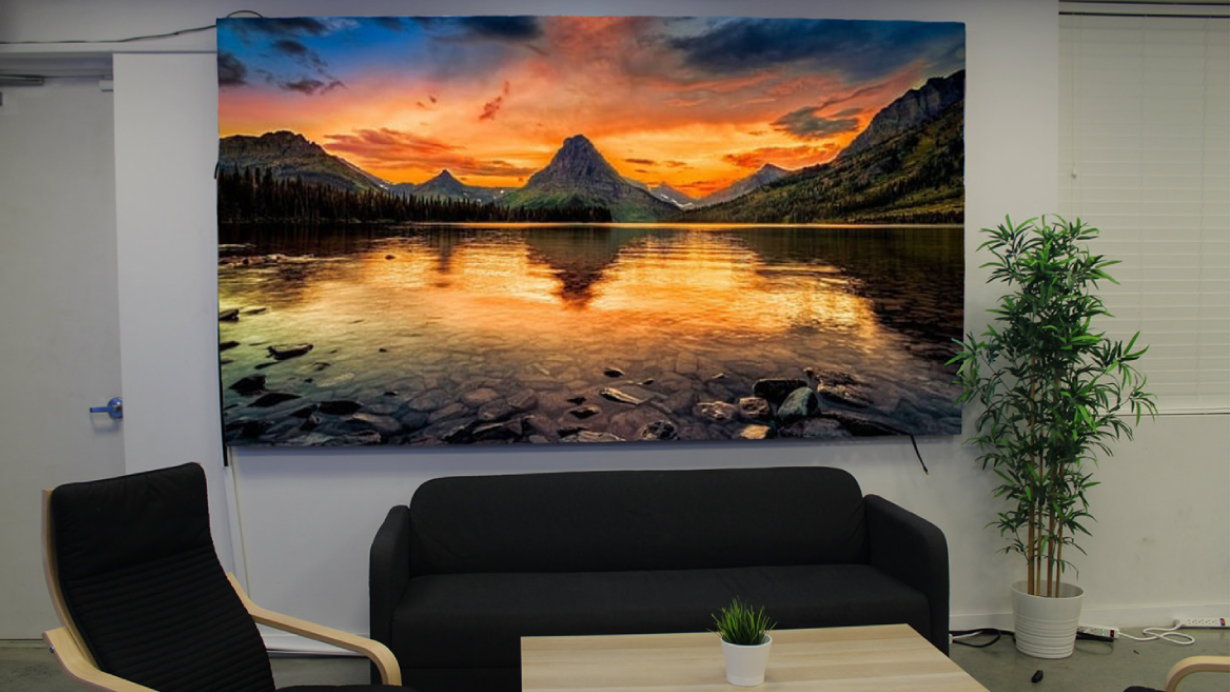
At ISE 2025 and in industry analysis, microLED and ultra-fine-pitch LED are identified as the next frontier. These deliver exceptional detail, useful where the board table is close to the screen, or when you need to display dense data or dashboards. For instance: COB (Chip-On-Board) LED modules are now being offered for boardroom/conference room applications, offering improved durability and optical performance.
Transparent, Curved & Flexible LED Surfaces
More than flat walls: transparent LED panels (glass-mounted), curved or wrap-around LED surfaces are gaining traction, especially where maybe the boardroom wall interfaces with lobby or atrium spaces. While less common in typical boardrooms, the trickle-down is that boardrooms can now consider “feature-wall” LED installations that also contribute to brand aesthetics when the room is idle.
Integrated All-In-One LED Solutions
New turnkey “all-in-one” dvLED displays are emerging: manufacturers offering built-in audio, signal processing, controller and simplified installation for corporate spaces. This reduces installation time, simplifies calibration and makes LED walls accessible for more boardrooms rather than just “mission-critical” rooms.
Sustainability & Energy Efficiency
Energy use, cooling, modularity and lifecycle costs are now more heavily scrutinised. Latest LED walls offer lower power consumption per square metre, better thermal management and longer lifespans, making them more appealing from a total cost-of-ownership (TCO) perspective.
Hybrid Collaboration Enhancements
Today’s boardroom display isn’t just “for-in-room only”. With hybrid meetings the norm, the LED wall must integrate with UC platforms (Microsoft Teams, Zoom, Webex) as well as interactive content sharing, digital whiteboarding, remote presenter feeds. For example, newer displays support multiple live windows simultaneously, side-by-side data feeds and dynamic layouts controlled by the AV/UC platform.
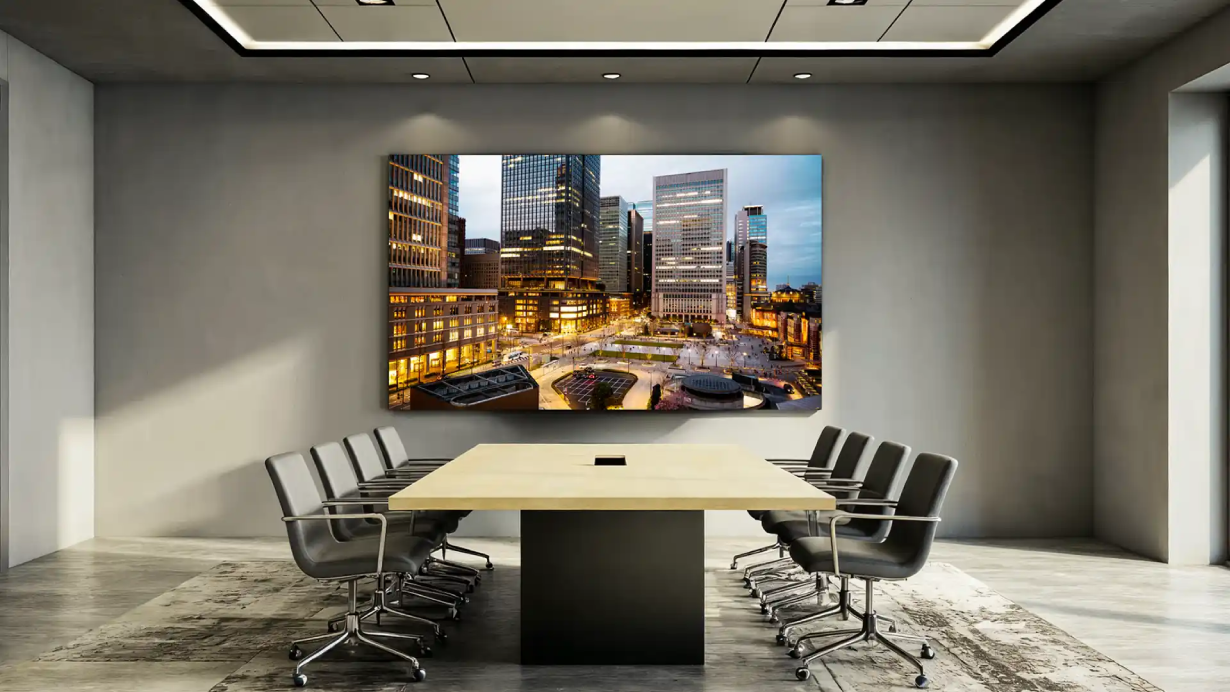
Designing the Boardroom Display: Key Considerations for 2025
When you’re specifying or revising a boardroom display, here are updated factors to include in your checklist:
- Viewing Distance & Pixel Pitch
Measure actual seating distance: when executives are just a few metres away, pixel pitch needs to be fine (≤ 1.2 mm or better) to avoid visible pixelation. In 2023 we cited ~1.2 mm as a workable balance. Today, if budgets allow, consider even 0.9 mm or 0.7 mm modules for premium boardrooms. Don’t over-spec: for larger rooms with greater distances, coarser pitch may suffice because savings can be significant. Brightness & Ambient Light
Boardrooms often have high ambient light (windows, glass walls, ceiling lighting). LED walls must have sufficient peak brightness, anti-glare treatment and robust contrast to maintain image fidelity. HDR capability is a bonus when showing rich content.- Aspect Ratio & Screen Format
While 16:9 is commonplace, modular LED walls allow custom aspect ratios (e.g., 21:9, panoramic). If the room architecture allows, consider wider formats for panoramic views or split layouts (e.g., board discussion + remote participants + data dashboards side-by-side). - Integration with UC & AV Systems
Make sure the LED wall supports multiple inputs (4K, HDR, IP-video streams), switching, multiple layout presets, remote content control and compatibility with your UC stack. Boardrooms necessitate high reliability, so include redundancy for signal routing, power backups and remote monitoring. - Acoustic & Ergonomic Considerations
Large LED walls can reflect sound so ensure acoustic treatment in the room (ceiling panels, wall absorbers). Also consider the board table layout so no one has their view blocked and that presenters can engage both in-room and remote participants. - Serviceability & Lifecycle
Look for modules/panels that allow easy front or rear-access service, hot-swappable power/signal boards and long warranties (100,000 hours is a good benchmark). Ensure the supporting frame, power management and cooling systems are designed for 24/7 use if required. - Budget & ROI
LED walls are still premium investments. Factor in not just hardware cost, but installation, calibration, control system, licensing, maintenance and life-cycle upgrades. Given the downward cost trend and improved performance, the TCO is more favourable than before. For many boardrooms the investment is justified by brand impact, improved collaboration and lower maintenance vs older tech (projectors, LCD walls).
| Feature | Large Flat Screens / LCD Video Wall | Modular dvLED Video Wall |
|---|---|---|
| Seamless appearance (no bezels) | Challenging at large size, visible seams/bezel breaks | Modular tiles allow seamless imagery |
| Flexible size/shape | Limited to standard screen sizes/aspect ratios | Custom size, shape, aspect ratios possible |
| Viewing distance/pixel pitch |
Usually optimised for mid-distance; fine detail may suffer | With fine pixel pitch, excellent even at close range |
| Brightness/ contrast/ambient light | Good for moderate ambient light, may need shading | High brightness, superb contrast, strong in highly lit rooms |
| Maintenance/ life-cycle | Commercial TVs may need replacement every 5-7 years, bulbs/projector lamps degrade | LED walls rated 100,000+ hours, modules replaceable, lower maintenance |
| Cost | Lower initial cost for modest sizes | Higher initial cost, but cost per m² has improved |
| Brand/presence impact | Functional but less “wow” | Strong visual impact, contributes to brand/image |
| Integration with multi-source layouts and interactivity | Possible, but may need extra processors/switchers | Built-for multi-window, interactive, large scale layouts |
Boardroom Display Updated Comparison: LED Wall vs Large-Format Flat Screens
In 2025, the verdict remains simple. For high-end boardrooms, the modular dvLED video wall increasingly makes sense. Organisations that want “good enough” may still opt for large flat screens, but those focused on prestige, data-rich visualisation or hybrid/remote collaboration will favour the LED wall.
Real-World Best Practices for Boardroom LED Walls
- Mock-up early: Given the large scale and architectural involvement, create a physical or 3D mock-up of the screen to verify viewing angles, seating layout, lighting and space constraints.
Future-proof for content: Ensure the display supports 4K+, HDR, multi-window layouts and can scale as meeting types evolve.
Consider content strategy: A massive LED wall should deliver more than just the presentation screen, it can show live dashboards, analytics, remote participant feed and immersive backgrounds.
- Plan for ambient light/sunlight: If the boardroom is glazed or has large windows, plan for shading, brightness control and anti-glare.
- Think about acoustic treatment and ergonomics: The screen may dominate the wall, but seats, table, lighting and sound must align with the new display so the experience remains comfortable.
Engage AV/UC integrator early: The LED system must integrate with microphones, cameras, collaboration platforms, control systems and room-automation. Choose a partner experienced in high-end boardrooms.
Maintenance & operations model: Define how the wall will be monitored, how modules can be swapped, what the backup strategy is (especially for high-uptime boards).
- Budgeting for upgrades: While the initial investment may be higher, the LED wall can avoid the 5-7-year cycle of replacing TVs/projectors and deliver a better TCO.
Why This Matters for Indian & APAC Corporations
For organisations in India and the broader APAC region, the boardroom is more than a meeting space, it’s a reflection of corporate identity, global ambition and investor confidence. A large, high-quality LED wall not only enhances the meeting experience but also helps project a technologically advanced and visionary culture.
Moreover, the market trends in India reflect:
- Significant growth in fine-pitch indoor LED video walls.
- The need for hybrid-capable boardrooms as work-styles evolve.
- ROI advantages via longer lifespans, lower maintenance and higher engagement.
- A differentiator for multinational or multinational-aspiring corporations seeking to present themselves on a global stage.
FAQ’s
Active LED video walls deliver seamless, bezel-free visuals, higher brightness and contrast and fully customisable sizing. They’re also more durable and scalable than projectors or large-format LCDs, making them ideal for premium corporate environments.
Yes. Modern dvLED walls integrate easily with platforms like Microsoft Teams, Zoom and Webex, supporting multi-source layouts, live data feeds and interactive content , making them perfect for hybrid meetings.
Absolutely. Newer models use efficient power supplies and better thermal management. With lifespans exceeding 100,000 hours and minimal maintenance, they offer a strong return on investment over their lifecycle.
